Most people think in categories. Energy is a category. Economics is a category. Policy is a category. You study them separately, specialize in one, and spend your career producing insights within that boundary.
I think in flows. Energy flows, material flows, information flows, capital flows. Not because I'm smarter than anyone - I'm not - but because I spent years unlearning the frameworks that school, business culture, and mainstream media had installed in my head, and replacing them with ones that actually describe how the world works.
This isn't a personality trait. It's a skill. It took me years, a lot of bad predictions, and a reading list that would make most people's eyes glaze over. But the payoff has been enormous. Once you see the world in flows instead of categories, certain things become obvious that were previously invisible. Why economic growth is slowing. Why institutions feel broken. Why the energy transition is harder than it looks. Why abundance is physically possible but structurally blocked.
Here are the six mental models that changed how I see everything.
Model 1: EROEI - The Master Variable
Where I learned it: Charles Hall, Nate Hagens, Vaclav Smil
Every conversation about energy eventually gets stuck on price. How much does a kilowatt-hour cost? What's the levelized cost of solar vs. gas vs. nuclear? These are useful numbers, but they obscure a deeper question: how much energy does it take to get energy?
This is EROEI - Energy Return on Energy Invested. You spend energy to drill a well, mine uranium, manufacture a solar panel. The energy you get back, divided by the energy you put in, is the ratio. And this ratio is the single most important number in understanding civilization.
When EROEI is high, everything is easy. You have surplus energy to build cities, fund science, support non-productive workers (artists, teachers, administrators), and still have leftovers. When EROEI drops, everything gets harder. More of your total energy output goes back into the energy system itself, leaving less for everything else.
The postwar economic boom? EROEI on conventional oil was 50:1 or higher. The "secular stagnation" we've seen since the 1970s? Global average EROEI has been falling steadily as we move from easy oil to deep water, tight shale, and tar sands.
| Energy Source | Approximate EROEI | Implication |
|---|---|---|
| Conventional oil (1950s) | 50-100:1 | Massive surplus, rapid industrialization |
| Conventional oil (today) | 15-20:1 | Still positive but declining returns |
| Shale oil / tar sands | 3-5:1 | Barely net positive, enormous environmental cost |
| Solar PV (installed) | 10-15:1 | Good, but variable and storage-dependent |
| Wind (onshore) | 15-25:1 | Strong, but intermittent |
| Nuclear (conventional) | 50-75:1 | Very high, but politically constrained |
| Thorium MSR (projected) | 200+:1 | Civilizational game-changer if deployed |
The shift this creates in your thinking is fundamental. You stop treating energy as a commodity - something you buy and sell on markets - and start treating it as a metabolic rate. Energy is the heartbeat of civilization. When the heart beats strong, the organism thrives. When it weakens, every organ suffers.
This is why I work on energy. Not because it's a good business opportunity (though it is), but because it's the master variable. Get energy right, and most other problems become solvable. Get it wrong, and nothing else matters.
Model 2: Tainter's Complexity Trap
Where I learned it: Joseph Tainter, "The Collapse of Complex Societies"
Joseph Tainter studied why civilizations collapse. Not particular civilizations - all of them. And he found a pattern so consistent that it amounts to a law.
Here's the pattern: every society faces problems. Drought, invasion, disease, inequality. The universal response is to add complexity. Create a new institution. Write a new law. Add a layer of bureaucracy. Build a standing army. Develop a new technology. Each addition of complexity solves the immediate problem. But it also costs energy, resources, and organizational capacity to maintain.
At first, the returns on complexity are high. Your first irrigation canal transforms agriculture. Your first legal code prevents blood feuds. Your first standing army deters invasion. But each successive addition yields diminishing returns. Your 500th regulation costs as much to administer as your first, but solves a much smaller problem. Your 12th layer of management adds overhead but no productivity.
The trap is this: societies cannot easily reduce complexity. Every institution, law, regulation, and bureaucratic layer has constituents who depend on it. Simplification looks like destruction to the people embedded in the system. So complexity ratchets upward until the cost of maintaining it exceeds the surplus the society generates. At that point, simplification happens anyway - but involuntarily, and we call it collapse.
Look at any large institution today through this lens and the pattern is unmistakable. Healthcare costs rise while outcomes stagnate. Education costs rise while learning outcomes decline. Government grows while trust in government falls. The cost of building infrastructure has increased by 200-300% in real terms since the 1960s. Not because concrete is more expensive, but because the complexity overhead - environmental reviews, permitting, litigation, compliance, insurance, stakeholder management - has compounded over decades.
The shift: stop asking "why doesn't the system work better?" That question assumes the system is trying to work well and failing. Tainter tells you the system is doing exactly what complex systems do - it's accumulating complexity until it can't sustain itself. The better question is: "what would it cost to make this simpler?" And who would resist that simplification, because their livelihood depends on the current complexity?
This is not an argument against governance or regulation. It's an observation that complexity has thermodynamic costs, and those costs compound. Any honest conversation about institutional reform has to start with this reality.
Model 3: Metabolic Thinking
Where I learned it: Simon Michaux, industrial ecology, systems biology
The dominant metaphor for civilization in business, policy, and economics is the machine. We talk about "economic engines," "policy levers," "market mechanisms." The machine metaphor implies that parts are replaceable. If one part breaks or becomes obsolete, you swap it out for a new one. The system keeps running.
This metaphor is wrong, and it leads to catastrophic errors in planning.
Civilization is not a machine. It is an organism. The difference matters enormously.
In a machine, parts are modular. A diesel engine and an electric motor are different technologies, but they both turn a shaft. Swap one for the other, done. In an organism, components are interdependent. Your liver doesn't just process toxins - it produces bile for digestion, synthesizes proteins for blood clotting, stores glycogen for energy regulation, and metabolizes hormones. You can't "swap out" a liver for something that only filters toxins. You'd lose all the co-functions.
Energy systems work the same way. Fossil fuels don't just produce electricity. Oil refining produces gasoline, diesel, jet fuel, heating oil, lubricants, asphalt, petrochemical feedstocks for plastics, synthetic rubber, pharmaceuticals, fertilizer precursors, and sulfur (which is used in mining and industrial chemistry). These are co-products of a single metabolic process. When someone says "just replace oil with renewables," they're thinking in machine terms - swap the engine. But you can't replace one substance that produces forty co-products with a technology that produces one. You'd need to replace all forty supply chains independently.
Simon Michaux's work on mineral requirements for the energy transition makes this viscerally concrete. To replace the current global fossil fuel infrastructure with renewables would require mining volumes that exceed known reserves of several critical minerals. Not because renewables are bad, but because the material metabolism of the two systems is fundamentally different, and we haven't accounted for the full metabolic cost of the transition.
The shift: stop thinking in substitutions and start thinking in metabolisms. When you evaluate any transition - energy, economic, technological - don't ask "what replaces the old thing?" Ask "what are all the flows the old system supported, and how does the new system maintain or replace each one?" This is harder. It's also the only way to avoid transition failures that cascade into crises.
This is why I'm skeptical of simple narratives about the energy transition. Not because I'm against renewables or nuclear or any particular technology. But because the metabolic complexity of the current energy system is vastly underappreciated, and plans that ignore it will fail in ways their advocates don't anticipate.
Model 4: Commons vs. Enclosure
Where I learned it: Elinor Ostrom, Mariana Mazzucato, the history of open source software
There's a story we tell about innovation in market economies. It goes like this: private companies, driven by competition and profit motive, invest in R&D, take risks, and produce breakthroughs. Government gets out of the way. The invisible hand allocates resources efficiently. The innovators get rich, and society gets the technology.
This story is almost entirely wrong.
Here's what actually happens. Government funds the foundational research - basic science, early-stage technology development, infrastructure. This is the high-risk, low-return work that no rational private investor would touch. The internet was a DARPA project. GPS was a military system. Touchscreen technology came from publicly funded research at CERN and the University of Delaware. mRNA vaccine technology was developed over decades with NIH funding.
Then, once the risk has been socialized and the technology is proven, private companies build products on top of it. Apple didn't invent any of the core technologies in the iPhone - it brilliantly integrated publicly funded innovations into a commercial product. SpaceX builds on decades of NASA research, NASA facilities, and NASA contracts. OpenAI was founded as a nonprofit with public-benefit rhetoric, then captured the value privately.
Elinor Ostrom won the Nobel Prize for demonstrating that commons - shared resources managed by communities - are not doomed to tragedy. In fact, they're often managed more sustainably than either private or state-owned alternatives. Her work demolished the "tragedy of the commons" myth that had been used for decades to justify privatization.
Mazzucato's contribution is showing the same pattern at the level of national innovation systems. The public sector takes the big risks. The private sector captures the returns. The public gets told that government is inefficient and markets are creative, when the reality is almost exactly reversed.
The open source software ecosystem makes this pattern visible at scale. The Linux Foundation estimates that open source software provides $8.8 trillion in value to the global economy. Companies like Google, Amazon, and Meta are built on open source foundations. The value was created in the commons and captured by enclosure.
| Innovation | Public Risk | Private Capture |
|---|---|---|
| The Internet | DARPA, NSF ($100B+ in today's dollars) | Google, Meta, Amazon |
| GPS | US military ($12B+ development) | Uber, DoorDash, logistics industry |
| mRNA vaccines | NIH ($31.9B over decades) | Moderna ($36B revenue in 2022 alone) |
| Touchscreens | CERN, University of Delaware | Apple, Samsung |
| SpaceX rockets | NASA ($7B+ in contracts, decades of research) | SpaceX ($350B+ valuation) |
| Large Language Models | Government-funded compute, academic research | OpenAI, Google, Anthropic |
The shift: stop asking "who invented this?" and start asking "who funded the risk and who captured the return?" This question restructures your understanding of virtually every major technology of the last century. Innovation doesn't come from competition. It comes from commons - shared knowledge, public funding, open protocols. Competition determines who captures the value. That's a very different thing.
This matters for how I think about building companies. The most durable value isn't captured by building walls. It's created by contributing to commons - open source tools, shared protocols, public knowledge - and then building services on top. The commons creates the ecosystem. The business serves the ecosystem. Try to enclose the commons and you eventually strangle the ecosystem that feeds you.
Model 5: Design Global, Manufacture Local
Where I learned it: Cosmolocalism research, P2P Foundation, Michel Bauwens
Globalization operates on a simple logic: make things where they're cheapest, ship them where they're needed. This logic works beautifully when shipping is cheap and supply chains are stable. It falls apart when either condition breaks.
We've watched it fall apart in real time. COVID-19 revealed that concentrating manufacturing in a few locations creates catastrophic fragility. A factory shutdown in Shenzhen means hospitals in Berlin run out of PPE. A drought in Taiwan means automakers in Detroit shut down production lines. A ship stuck in the Suez Canal costs the global economy $9.6 billion per day.
The cosmolocalists propose a different model: Design Global, Manufacture Local (DGML). The principle is simple. Light things should travel far. Heavy things should stay close.
Knowledge is light. Designs, software, protocols, research, blueprints - these weigh nothing and can be shared globally at near-zero cost. Physical goods are heavy. Raw materials, finished products, food, energy - these cost energy to transport, and the transport creates fragility.
The optimal system, then, shares knowledge globally and manufactures locally. Open source hardware designs that anyone can produce. Distributed manufacturing networks using local materials. Energy systems that generate power where it's consumed. Food systems that produce near the point of need.
This isn't utopian speculation. It's already happening in software (open source), in manufacturing (3D printing, fab labs), and in energy (distributed solar, microgrids). The question is whether it can scale to reorganize the physical economy the way open source reorganized software.
The shift: stop thinking about scale as "bigger" - more centralized, more concentrated, more efficient through volume. Start thinking about scale as "more distributed" - more nodes, more redundancy, more local capacity. A network of 10,000 small manufacturers is more resilient than one megafactory, even if it's less "efficient" in narrow economic terms. Resilience is a form of efficiency that standard economics doesn't measure.
This model connects directly to energy. A distributed energy system - small modular reactors, community solar, local microgrids - fits the DGML pattern perfectly. The designs are global. The deployment is local. The resilience is built into the structure, not bolted on as an afterthought.
Model 6: The Sun as First Principle
Where I learned it: Thermodynamics, studying the Heliogenesis concept
Here's a number that should restructure your entire worldview: 172,000 terawatts.
That's the amount of solar energy that hits Earth continuously. Our entire civilization - all industry, all transport, all heating and cooling, all computing, all agriculture, everything - uses about 18 terawatts. We use roughly 0.01% of the energy that arrives at our planet's surface every second of every day.
The implication is staggering. We are not energy-constrained. We have never been energy-constrained. We are design-constrained. The energy is here. It has always been here. What's missing are the systems to capture, convert, store, and distribute it effectively.
This flips the entire scarcity narrative on its head. Most economic thinking is built on the assumption that resources are scarce and the challenge is allocation. But energy is not scarce in any physical sense. It's abundant beyond comprehension. The scarcity we experience is an artifact of our energy capture systems - their efficiency, their distribution, their design.
If you start from the sun as first principle, several things follow:
Scarcity is a design problem, not a resource problem. There is no shortage of energy. There is a shortage of systems that convert solar flux into useful work. Every discussion about "running out" of something is really a discussion about inadequate conversion technology.
Abundance is physically possible. The energy exists to desalinate all the water we need, to power all the industry we want, to run all the computation we can imagine. The constraint is never the source. It's always the system.
The transition is a design challenge, not a resource challenge. We don't need to find more energy. We need to design better systems for using the energy that's already here. This includes direct solar capture, but also nuclear (which is just using the energy of another star, concentrated and stored in heavy elements), wind (solar energy converted to atmospheric motion), and biomass (solar energy stored in chemical bonds).
The shift: stop arguing about whether we have enough. We have enough. We have 10,000 times enough. Start designing systems that use what's already here. The intellectual energy currently spent on scarcity debates would be better spent on conversion engineering, distribution architecture, and institutional design.
This is, at its core, what Heliogenesis means. Not a specific technology, but a reorientation of civilization toward its primary energy source. We've spent 200 years building an industrial civilization on stored ancient sunlight (fossil fuels). The next chapter is building on current sunlight - directly, efficiently, and at scale.
How the Models Fit Together
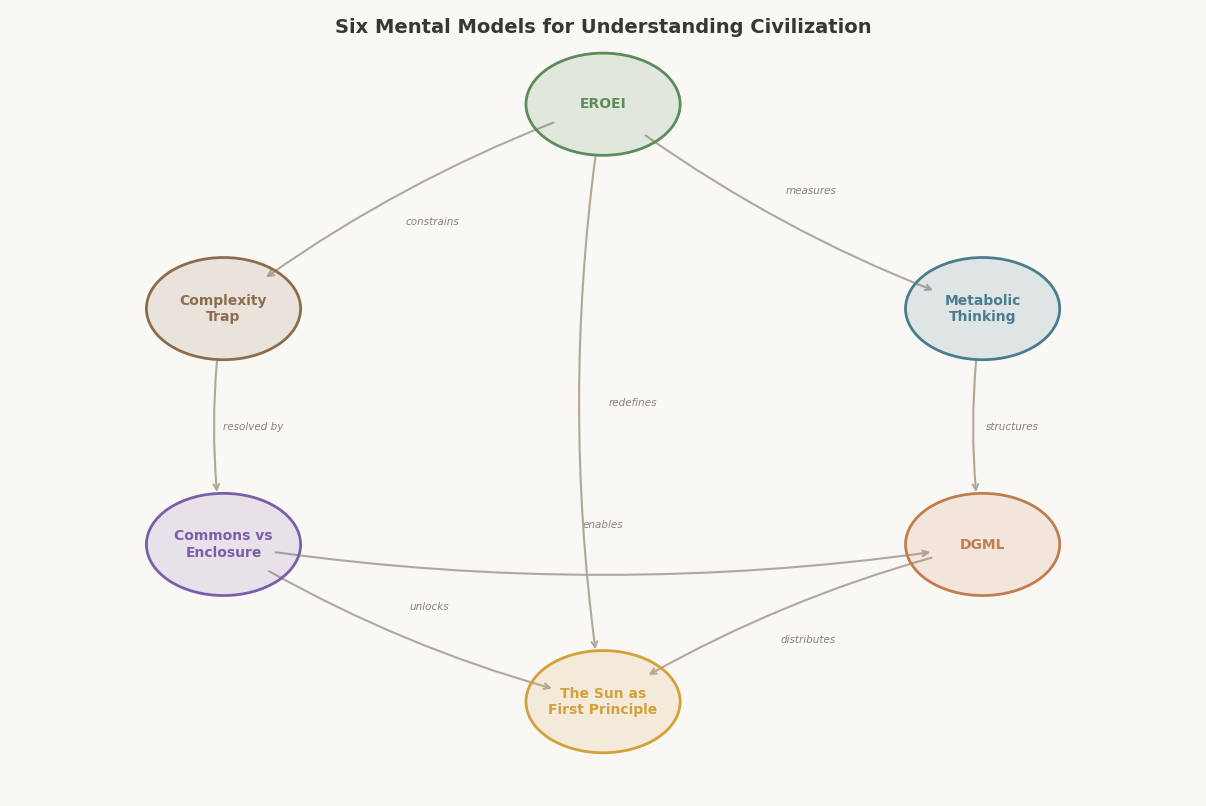
These six models aren't separate frameworks for separate domains. They're layers of the same understanding, each illuminating a different facet of the same underlying reality.
EROEI tells you the constraint. Net energy surplus is what makes complexity possible. When surplus shrinks, everything downstream gets harder.
Tainter tells you the trap. Civilizations respond to problems by adding complexity, which consumes surplus, which creates more problems. It's a feedback loop with a thermodynamic ceiling.
Metabolic thinking tells you the dependencies. You can't understand transitions without mapping the full flow - the co-products, the interdependencies, the material requirements that don't show up in simple substitution models.
Commons shows you what works. The most important innovations and the most resilient systems emerge from shared resources, not enclosed ones. Public risk, shared knowledge, and open protocols create more value than private capture ever could.
DGML shows you the structure. Light things global, heavy things local. Design for distribution, not concentration. Build resilience into the architecture, not as an add-on.
The sun shows you the source. 172,000 terawatts. The constraint was never energy. It was always design.
Together, these models form a coherent worldview: civilization is a metabolic system running on energy surplus, trapped in escalating complexity, but sitting on a practically infinite energy source. The path forward runs through commons-based knowledge sharing, distributed manufacturing, and solar-powered (in the broadest sense) design.
This isn't optimism. It's not pessimism either. It's engineering clarity. The physics says abundance is possible. The history says complexity is the trap. The economics says commons create more value than enclosures. The engineering says distribute, don't concentrate. And the thermodynamics says start with the sun.
I didn't learn this in school. I learned it by reading people who spent their careers measuring actual energy flows, studying actual collapses, mapping actual material dependencies, and documenting actual commons. The mainstream narrative - growth is natural, markets are efficient, technology will save us, scarcity is inevitable - is not just wrong. It's a set of frameworks that actively prevent you from seeing the real structure of the world.
Swap the frameworks and the world looks different. The problems are still hard, but they become tractable. And the path forward - while not easy - becomes visible.
That's what systems thinking gives you. Not answers. Visibility.