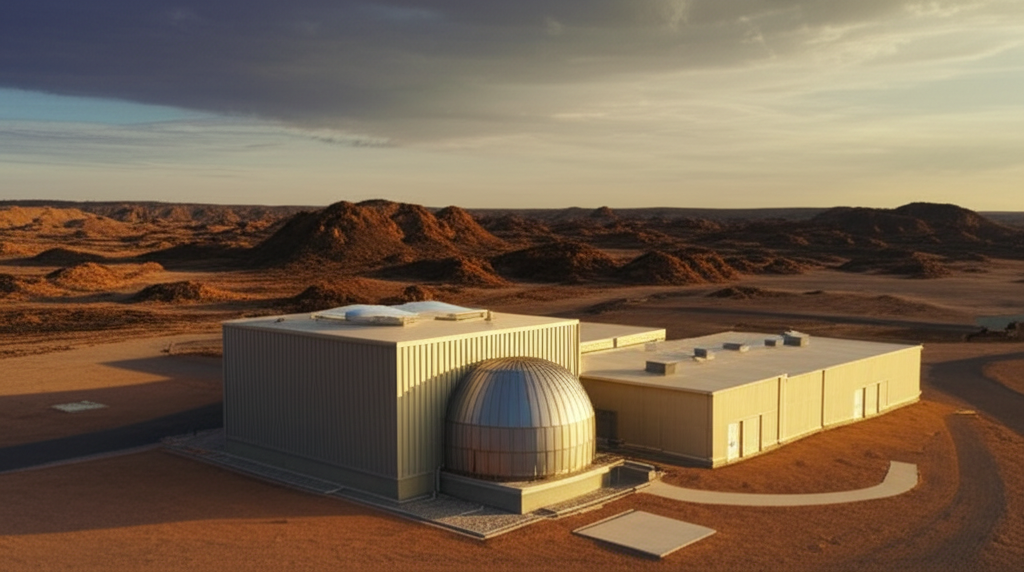
In 2023, in the Gobi Desert near Wuwei, Gansu province, the Chinese Academy of Sciences achieved first criticality on the TMSR-LF1 - a 2 megawatt experimental thorium molten salt reactor. It was the first reactor of its kind to operate since Oak Ridge National Laboratory shut down its Molten Salt Reactor Experiment in 1969.
Most coverage of this event was shallow. "China builds thorium reactor" headlines, followed by a paragraph about clean energy and a quote from someone at a think tank. Almost nobody explained how the thing actually works - the physics, the chemistry, the engineering, the materials, the unsolved problems.
This article is the explanation I wished existed. It goes deep. If you want to understand what makes the TMSR-LF1 genuinely different from every reactor operating today - not as a talking point, but as physics and engineering - this is where we start.
The core idea: fuel dissolved in the coolant
In a conventional nuclear reactor, solid uranium fuel rods sit in pressurized water. The water serves as coolant and moderator. The fuel stays in one place. The coolant flows around it.
The TMSR-LF1 inverts this entirely. There are no fuel rods. No cladding. No solid fuel at all. Instead, thorium and uranium fluoride salts are dissolved directly into a molten fluoride salt mixture that flows through the reactor like a liquid. The fuel is the coolant. The coolant is the fuel.
This single design choice - dissolving the fuel into the working fluid - cascades into almost every advantage and every challenge of the technology.
The fuel cycle: thorium becomes uranium
Thorium-232 does not fission. It is "fertile," not "fissile" - it absorbs neutrons but does not split. This sounds like a limitation. It is actually the mechanism.
When Th-232 absorbs a neutron, it begins a transformation chain through two natural radioactive decays:
Th-232 absorbs neutron -> Th-233 (unstable, 22 min half-life) beta decays -> Pa-233 (unstable, 27 day half-life) beta decays -> U-233 (fissile - splits and releases energy)
Beta decay is simple: a neutron in the nucleus converts to a proton and emits an electron. The atom becomes a different element. It happens automatically. You just wait.
So thorium slowly cooks itself into fuel. The reactor is simultaneously a power plant and a fuel factory. Each U-233 fission releases energy and roughly 2.4 neutrons - one sustains the chain reaction, the remaining 1.4 are available to convert more thorium into new fuel. You are breeding your own fuel as you burn it.
This is profoundly different from the conventional uranium fuel cycle, where you mine enriched U-235, burn it, and dispose of the spent fuel. The thorium cycle is closer to a closed loop.
The neutron economy: where reactor design lives or dies
The breeding chain only works if you have enough neutrons for three jobs simultaneously:
- Keep U-233 fissioning - sustain the chain reaction
- Convert fresh Th-232 into new U-233 - breed new fuel
- Overcome losses - neutrons absorbed by the salt, vessel walls, fission products, and structural materials
With ~2.4 neutrons per fission and 1 needed for sustaining the reaction, you have ~1.4 for breeding and losses. In practice, parasitic absorption eats into that margin significantly. This is why the neutron economy - accounting for every neutron in the system - is the central discipline of reactor design. Every material choice, every geometry decision, every chemistry parameter ultimately comes back to: does this help or hurt the neutron budget?
Why neutron speed matters: the moderation problem
Neutrons come out of fission fast - roughly 2 million electron volts of kinetic energy. At that speed, they are terrible at causing more fission. The cross-section - think of it as the effective target size of the nucleus - is tiny at high energies.
Slow the neutron down to thermal energy, about 0.025 eV, and the cross-section explodes by a factor of roughly a thousand. The nucleus suddenly looks enormous to the incoming neutron.
How do you slow them down? Elastic scattering - bouncing off nuclei like billiard balls. Maximum energy transfer happens when the two masses are equal. A neutron hitting a heavy uranium nucleus barely slows down (ping pong ball hitting a bowling ball). A neutron hitting a hydrogen nucleus - same mass - can stop in a single collision. This is why water is such an effective moderator in conventional reactors.
The TMSR-LF1 uses FLiBe - lithium fluoride plus beryllium fluoride - as its carrier salt. FLiBe moderates neutrons, but less aggressively than water. The neutron spectrum sits somewhere between fully thermal and epithermal - a "soft" spectrum. This actually helps breeding efficiency slightly, because some resonance-energy neutrons get captured by Th-232 very efficiently at specific energy windows.
But the lithium must be isotopically enriched to more than 99.99% Li-7. Natural lithium contains 7.5% Li-6, which absorbs neutrons parasitically and produces tritium. This enrichment requirement is one of the most expensive materials challenges in the entire design - and one of the most geopolitically significant, as we will see.
What the molten salt actually does
The FLiBe salt mixture serves four jobs simultaneously:
| Role | How |
|---|---|
| Fuel carrier | UF4 and ThF4 dissolved directly in the salt |
| Coolant | Salt absorbs fission heat, flows to heat exchanger |
| Moderator (partial) | Slows neutrons to effective energy range |
| Waste processor | Fission products dissolve into salt, can be chemically extracted continuously |
The salt melts around 460 degrees C and operates around 700 degrees C. At atmospheric pressure. Compare that to a pressurized water reactor running at 155 atmospheres. The engineering stress difference between atmospheric pressure and 155 atmospheres is not incremental - it is categorical. It eliminates entire classes of failure modes.
The protactinium problem
This is the step most articles skip.
Pa-233 has a 27-day half-life. While it sits in the reactor waiting to become U-233, it can absorb another neutron and become Pa-234, which decays to U-234 - mostly useless. Every Pa-233 that gets hit by a stray neutron is a U-233 atom you never get. You lose breeding potential.
The engineering solution: continuously extract Pa-233 from the salt before it absorbs another neutron, let it decay to U-233 outside the core over about 9 months (ten half-lives), then feed the U-233 back into the reactor.
This requires an online reprocessing loop - chemically separating elements from radioactive molten salt in real time. At 700 degrees C. While everything is intensely radioactive. This is one of the main unsolved engineering challenges of the TMSR at scale.
Waste: why the half-life drops so dramatically
Conventional uranium reactors produce transuranics - plutonium, americium, neptunium - with half-lives of 10,000 to 100,000 years. These accumulate because solid fuel rods cannot be continuously processed. Everything stays in the rod until it is removed years later.
In the thorium cycle, U-233 fissions cleanly with far fewer heavy transuranic byproducts. The dominant fission products - cesium, strontium, lighter elements - have half-lives of 30 to 300 years. And continuous salt processing lets you pull these out before they accumulate and poison the neutron economy.
The waste problem does not disappear. But it collapses from a geological timescale problem (100,000 years) to a civilizational one (300 years). That is still a long time. But we build cathedrals that last longer.
How the reactor regulates itself
This is the most important section of this article. Everything above is interesting. This is why the TMSR is fundamentally safer than conventional reactors - not as a regulatory claim, but as physics.
The Doppler effect in nuclei
When U-233 nuclei get hotter, they vibrate faster. An incoming neutron sees a spread of relative velocities - the nucleus is a moving target. This broadens the effective energy range over which the nucleus interacts with neutrons. The resonance peaks in the absorption cross-section get shorter and wider.
The critical physics: this Doppler broadening increases parasitic absorption by Th-232 more than it increases U-233 fission. As temperature rises, thorium captures more neutrons, removing them from the fission chain.
Temperature rises -> more neutrons absorbed by thorium -> fewer fissions -> power falls.
This is automatic. No sensors. No control rods. No human action. Pure physics. The temperature coefficient is approximately -3 to -5 pcm per degree C. A 100 degree C excursion reduces reactivity by 300 to 500 pcm - enough to suppress a power spike before any engineered system even registers the change.
The density effect: liquid fuel changes everything
In a solid fuel reactor, fuel and coolant are separate. Thermal expansion of fuel is constrained by the rod cladding. The fuel stays where it is regardless of temperature.
In the TMSR, fuel and coolant are the same liquid. When power increases and the salt heats up:
- Salt thermally expands and becomes less dense
- Lower density means fewer fissile atoms per unit volume
- Less dense salt means fewer moderating collisions - neutrons stay faster, less efficient at causing fission
- Salt physically flows out of the core as it expands - fuel leaves the active zone by itself when it gets too hot
That last point is crucial. The reactor expels its own fuel when it overheats. No mechanical system required.
The void coefficient: why Chernobyl is physically impossible here
The TMSR operates at 700 degrees C at near-atmospheric pressure. The salt boiling point is approximately 1400 degrees C. There is a 700-degree margin before boiling is even possible.
If voids (bubbles) do form - from fission gas or helium sparging - they displace fissile salt from the core. Less fissile material means less reactivity. The void coefficient is negative. Adding voids reduces power.
Compare this to the RBMK reactor at Chernobyl, which had a positive void coefficient. When coolant boiled away, reactivity increased, which caused more boiling, which caused more reactivity - a feedback loop with no natural ceiling.
The combined feedback
Imagine a sudden power spike:
- Salt temperature rises (milliseconds)
- Doppler broadening: Th-232 absorbs more neutrons, k drops
- Salt expands: fuel density drops, some salt leaves core, k drops further
- Power increase self-limits within seconds
- New equilibrium at slightly higher temperature
- Operator notices, adjusts control rods over minutes
- Temperature returns to setpoint
The physics handles the transient on millisecond timescales. Humans do not even perceive the problem before it is already solved.
The delayed neutron subtlety
About 0.26% of neutrons from U-233 fission are delayed - emitted by fission product nuclei over timescales of milliseconds to minutes. This tiny fraction is what makes any reactor controllable by mechanical systems. Without delayed neutrons, the reactor period (doubling time) would be milliseconds - physically impossible to control.
The TMSR has a complication: because the salt flows, some delayed neutron precursors get carried out of the core before they emit their neutron. The effective delayed neutron fraction drops from about 0.26% to about 0.20%. U-233 already has fewer delayed neutrons than U-235 in conventional reactors (0.65%). This makes the TMSR slightly harder to control mechanically.
It is compensated by the strongly negative temperature coefficient - Doppler feedback acts faster than delayed neutrons matter anyway - and by the continuous flow mixing any local perturbation across the entire salt volume.
The salt chemistry: extracting things from liquid fire
You have flowing liquid at 700 degrees C containing ThF4 (fertile fuel), UF4 (fissile fuel), FLiBe (carrier salt), accumulating fission products, and protactinium. All intensely radioactive and corrosive. The engineering is almost absurdly demanding.
Noble gas removal (relatively easy)
Xenon and krypton are noble gases. They do not bond to anything. They bubble out of the salt naturally. A helium sparging system - helium bubbles blown through the salt - carries them out for separate capture.
This matters enormously because Xe-135 is the most powerful neutron poison known. It absorbs neutrons roughly 3 million times more effectively than most materials. In solid fuel reactors, it accumulates in the rods and causes instability - this contributed to Chernobyl. In the TMSR, it simply leaves. Continuously. One of the most dangerous fission products becomes one of the easiest to manage.
Protactinium extraction (hard)
The method is reductive extraction using liquid bismuth. Bismuth melts at 271 degrees C, so at 700 degrees it is fully liquid. You flow it alongside the salt in a contactor column and add lithium metal to the bismuth as a reducing agent:
PaF4 (in salt) + 4Li (in bismuth) -> Pa (in bismuth) + 4LiF (in salt)
Protactinium transfers into the bismuth layer. You separate the bismuth, let the Pa decay to U-233 over about 9 months, then reverse the process to push U-233 back into the salt.
The nightmare: bismuth embrittles steel. At reactor temperatures, liquid bismuth penetrates metal grain boundaries. Standard stainless steel cracks and fails. The TMSR program uses Hastelloy-N (a nickel-molybdenum alloy developed at Oak Ridge in the 1960s) with ongoing research into carbon-carbon composites and tungsten-lined vessels for the bismuth contact zones.
Rare earth removal (critical for breeding)
Rare earth fission products - lanthanum, cerium, neodymium - dissolve stably in fluoride salt and absorb neutrons strongly. If they accumulate, they slowly strangle the chain reaction by eating the neutron budget.
Removal requires fluorinating a side-stream of salt (bubbling fluorine gas through it), which volatilizes uranium as UF6 gas. The remaining salt with rare earths goes through bismuth extraction similar to the Pa step. Clean salt and recovered uranium return to the reactor.
The energy cost and complexity of running this chemistry continuously, on a radioactive salt stream, at 700 degrees C, is the central reason no molten salt reactor has yet operated at commercial scale.
The full reprocessing loop
REACTOR CORE
    | (salt flows out at 700 degrees C)
    v
Noble gas sparger -> Xe, Kr removed passively
    |
    v
Pa extractor (bismuth contactor) -> Pa removed, decays to U-233, returned later
    |
    v
Rare earth extractor (fluorination + bismuth) -> neutron poisons removed
    |
    v
Heat exchanger -> electricity generation
    |
    v
Clean salt returns to core
The whole loop runs continuously while the reactor operates. No shutdowns for refueling. No spent fuel rods. The reactor is partly a power plant, partly a continuously running radiochemistry laboratory.
The freeze plug: passive safety made physical
At the bottom of the reactor vessel, a pipe leads to emergency drain tanks. In this pipe sits a section that is actively cooled - a small refrigeration system keeps that section of salt frozen solid. The frozen salt is the valve.
Normal operation: Cooling system runs. Plug stays frozen. Salt stays in reactor.
Loss of all power: Cooling stops. The 700 degree salt above conducts heat down. The plug melts within minutes. Salt drains by gravity into subcritical drain tanks. Reaction stops. Decay heat dissipates passively.
No power needed. No operator action. No valves to open. No pumps to start. The default state of the system without energy input is safe.
The drain tanks are geometrically designed so that even if the entire salt inventory drains into them, the fissile material is too spread out to sustain a chain reaction. They are surrounded by passive heat removal - natural convection air cooling that works without any pumps or power.
There is a philosophical subtlety worth noting: the freeze plug requires active cooling to stay frozen. It requires continuous power to remain closed. Some critics call this an active safety system. Defenders counter that the failure mode is safe - power loss means the plug melts, salt drains, reactor shuts down. The active power maintains normal operation, not safety.
The engineering systems
The primary pump
The pump must move highly radioactive, corrosive, 700 degree molten salt continuously for years without maintenance access. It must not leak. It must not introduce contaminants. And it must handle salt that solidifies at 460 degrees C if it slows or stops.
The solution is a centrifugal sump pump with the motor sitting above the biological shielding, connected to the impeller by a 2-4 meter long drive shaft penetrating down into the salt. The motor stays cool and accessible. Only the bottom impeller touches the salt.
Conventional bearings use oil lubrication - impossible near 700 degree radioactive salt. Instead, pressurized helium gas creates a thin cushion between shaft and bearing surfaces. No contact, no wear, no lubrication needed.
Where the shaft enters the salt vessel, a freeze seal forms - the shaft passes through a cooled region where salt deliberately freezes around it, creating its own seal. The salt seals itself.
The heat exchanger
The primary radioactive salt transfers heat to a clean secondary salt loop, which then drives a turbine. This intermediate loop exists purely to prevent any radioactive contamination from reaching the power generation side.
At 700 degrees C, conventional water-steam cycles peak around 35% efficiency. The TMSR program is targeting supercritical CO2 Brayton cycle turbines - CO2 at supercritical conditions drives a compact turbine at 45-50% thermal efficiency. This is relevant for the Gobi Desert location - water scarcity makes steam cycles impractical at scale, which was part of the site selection logic.
The off-gas system
The salt surface sits under a helium blanket. Into this cover gas, the salt continuously releases fission gases, trace tritium, and volatile fission products. The off-gas train processes this through particle filters, activated charcoal delay beds (where short-lived isotopes decay before release), tritium removal systems, and iodine traps using silver zeolite.
The charcoal delay bed is critical: by holding the gas stream on charcoal for 30-60 days, most short-lived isotopes decay to negligible levels. Only Kr-85 (10-year half-life) and long-lived isotopes remain, compressed into cylinders for disposal.
The materials wall
The physics was proven in the 1960s at Oak Ridge. The chemistry is understood in principle. What remains unsolved at scale is materials science.
Hastelloy-N: the baseline structural material
Developed at Oak Ridge specifically for molten salt service. Roughly 72% nickel, 16% molybdenum, 7% chromium. Nickel was chosen because nickel fluoride is thermodynamically stable - nickel resists dissolving into fluoride salt.
The problem Oak Ridge found after two years of operation: tellurium, a fission product, diffuses into the metal and causes intergranular cracking. Additionally, neutron bombardment transmutes nickel into helium atoms that get trapped at grain boundaries.
China's TMSR program has been testing modified Hastelloy-N with small additions of niobium (about 2%) since 2011. The niobium ties up grain boundaries and resists tellurium attack. Published data suggests significant improvement, but long-term (decades) data does not exist yet. The TMSR-LF1 is generating that data right now.
The bismuth vessel problem
Liquid bismuth at 700 degrees C attacks Hastelloy by penetrating metal grain boundaries - liquid metal embrittlement. Candidate solutions include tungsten-lined vessels (tungsten is insoluble in bismuth but extremely difficult to machine), carbon-carbon composites (excellent properties but radiation causes dimensional changes), and silicon carbide composites (leading candidate for next-generation designs, but the joining problem - how to seal SiC components without metal joints - remains unsolved).
The tritium challenge
Li-7 under fast neutron bombardment still produces small amounts of tritium, which permeates through hot metal walls and is nearly impossible to fully contain. Approaches include double-walled heat exchangers with tritium capture zones, palladium membranes (palladium is uniquely permeable to hydrogen isotopes, allowing selective extraction - but costs around $50,000 per kilogram), and yttrium or zirconium getter beds.
A 373 MW LF2 would produce roughly 20-200 Ci per day of tritium. Manageable, but requiring careful engineering and monitoring.
The materials readiness picture
| Ready now | Needs work | Unsolved at scale |
|---|---|---|
| ThF4, UF4 production | Modified Hastelloy-N (niobium variant) | Long-term Hastelloy under sustained neutron flux |
| FLiBe chemistry (well understood) | SiC composite joining | Bismuth vessel lining at scale |
| Nuclear graphite (existing industry) | Supercritical CO2 turbines | Tritium total containment |
| Li-7 enrichment (exists, small scale) | Pd tritium membranes | Online reprocessing chemistry at scale |
The geopolitics of TMSR materials: who controls what
This is where nuclear physics becomes resource strategy. The materials stack for a TMSR maps onto a geopolitical control structure that most energy commentators have not yet noticed.
Lithium-7: the single most critical vulnerability
Without isotopically pure Li-7, FLiBe salt does not work. There is no substitute.
Russia controls roughly 60% of global Li-7 enrichment capacity. China holds about 30% and is growing fast. The United States has approximately 0% currently operational - it shut down its enrichment capability in 1963 after the COLEX process (which used mercury) caused severe environmental contamination at the Oak Ridge Y-12 plant. The site is still a Superfund cleanup zone.
The US has been entirely dependent on Russian Li-7 imports for its existing reactor fleet. When sanctions discussions began after 2022, the nuclear industry quietly panicked. New enrichment methods are in development - crown ether processes, ionic liquid extraction, laser isotope separation - but optimistic estimates put Western independence at 10-15 years away.
China produces its own. Everyone else is scrambling.
Beryllium: toxic, rare, and concentrated
BeF2 is the other half of FLiBe. In the Western world, beryllium is essentially a monopoly - one American company (Materion, formerly Brush Engineered Materials) controls the supply chain from the Spor Mountain deposit in Utah through refining at their plant in Elmore, Ohio.
Berylliosis - chronic beryllium disease from dust inhalation - makes processing politically difficult to site and operate. At TMSR scale, you need hundreds of tonnes of BeF2. This is one reason some next-generation designs explore beryllium-free salts at the cost of some performance.
Thorium: abundant but stranded
Ironically, the fuel is the least of the supply chain problems. India holds the world's largest reserves (846,000 tonnes), followed by Brazil, Australia, the US, and China. Thorium is currently a waste product of rare earth mining - it comes with monazite sand, and because it is mildly radioactive, most processors bury it to avoid regulatory burden.
China's Bayan Obo mine in Inner Mongolia produces roughly 70% of global rare earths. It also sits on enormous thorium deposits currently classified as waste. As the TMSR program scales up, this waste stream becomes strategic fuel inventory. A remarkable resource convergence.
Molybdenum and nickel: Hastelloy supply chain
China controls roughly 45% of global molybdenum production. Nickel supply is more distributed but competes directly with EV battery demand. Nuclear-grade Hastelloy-N requires extensive certification and only a handful of mills globally can produce it - Haynes International in the US and VDM Metals in Germany are the primary Western sources.
The control map
| Material | China position | Western vulnerability | Timeline to fix |
|---|---|---|---|
| Li-7 enrichment | Strong (30%+) | Critical (0% domestic) | 10-15 years |
| Beryllium | Developing | Manageable (US monopoly) | 3-5 years |
| Thorium | Large reserves | Low (abundant globally) | Now |
| Molybdenum | Dominant (45%) | Moderate | 5-7 years |
| Rare earths | Dominant (85%) | Critical | 7-10 years |
| Hastelloy-N manufacturing | Developing | Manageable | 2-3 years |
The strategic picture
China's TMSR program is not just an energy project. It is a vertical integration strategy across the entire critical materials stack: largest thorium reserves from the Bayan Obo waste stream, dominant rare earth processing, growing Li-7 enrichment breaking the Russian near-monopoly, domestic Hastelloy-N development, and molybdenum production dominance. All directed by a state apparatus with institutional patience measured in decades, not electoral cycles.
The West is building TMSR programs - Terrestrial Energy in Canada, Moltex in the UK, Flibe Energy in the US - against a fragmented, market-driven supply chain with critical single points of failure.
The uncomfortable framing: if molten salt reactors become the dominant electricity technology of the late 21st century the way lithium-ion batteries became dominant in transportation, the country that controls the materials stack controls energy geopolitics. China appears to be playing a 50-year game. Most Western governments are playing a 4-year one.
What the TMSR-LF1 is actually doing right now
The 2 MW TMSR-LF1 is not primarily a power source. It is a materials testing program dressed as a reactor. Every component they run to failure gives them data no laboratory experiment can replicate:
- Hastelloy-N corrosion rates under real neutron flux and real fission product chemistry
- Tellurium intergranular attack rates on niobium-modified alloys
- Tritium permeation through primary circuit materials at operating temperature
- Freeze plug thermal behavior under actual transient conditions
- Pump seal and bearing wear rates in real salt service
- Neutron kinetics with flowing fuel - delayed neutron precursor loss measurements at different flow rates
Every hour of operation feeds the engineering database that the 373 MW TMSR-LF2, planned for the early 2030s, will be designed from.
The physics says it works. The chemistry says it works. The engineering question is whether all these systems can be made reliable enough, maintainable enough, and manufacturable at scale - for 40 years, in a desert, without the kind of industrial supply chain that surrounds conventional nuclear plants.
700 researchers at the TMSR Center in Shanghai are working on exactly this. Largely under Western radar.
The honest summary
The TMSR-LF1 represents a genuinely different approach to nuclear energy - not an incremental improvement on existing reactor designs, but a fundamental rethinking of the relationship between fuel, coolant, safety, and waste.
Its safety case rests not on engineered backup systems but on physics: negative temperature coefficients that suppress power excursions on millisecond timescales, density effects that physically remove fuel from the core when it overheats, and a freeze plug that drains the reactor to safe geometry when all power is lost. These are not regulatory checkboxes. They are thermodynamic inevitabilities.
Its challenges are equally real: materials that must survive 700 degree corrosive radioactive salt for decades, online reprocessing chemistry that has never been demonstrated at scale, tritium containment across an entire primary circuit, and a supply chain for critical materials - especially Li-7 - that is concentrated in countries that may not share.
The TMSR-LF1 is a 2 MW experiment. The jump to 373 MW commercial scale is enormous. But every reactor technology that powers the world today made a jump like that at some point - from research curiosity to engineered reality. The question is not whether the physics works. The question is whether the materials hold, whether the chemistry scales, and whether anyone outside China is willing to make the sustained, patient, multi-decade investment required to find out.
China is making that investment. The rest of the world is watching.
Whether that turns out to be wisdom or complacency depends entirely on what happens in the next ten years.