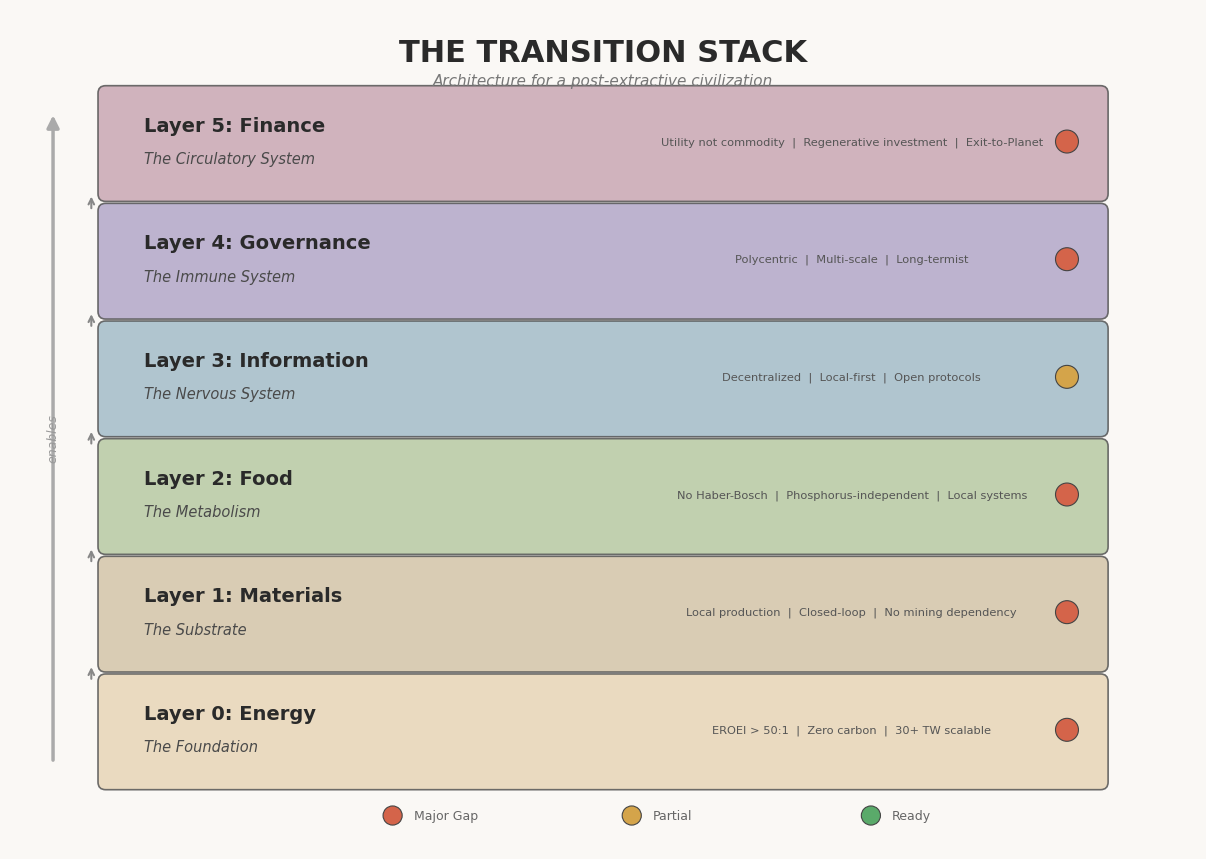
If you were designing a civilization from scratch - one that could sustain 10 billion people indefinitely without depleting its substrate - what would the architecture look like?
This is not a thought experiment. This is the design brief for the next 50 years.
Every system architect knows that you do not build a platform by starting with the user interface. You start with the foundation layer and work up. Each layer depends on the ones below it. Get the ordering wrong and nothing above it works. Get the interfaces wrong and the layers cannot communicate. Skip a layer entirely and the whole thing collapses under load.
Civilizations work the same way. The reason we struggle to fix climate change, resource depletion, inequality, and governance failure independently is that they are not independent problems. They are layers in a stack. And right now, every layer is running legacy code - extractive protocols designed for a world of 2 billion people with seemingly infinite resources.
We need a migration plan. Not a manifesto. Not a utopia. A technical specification for how to get from here to there, layer by layer, with clear requirements, current status, and gap analysis for each.
Here is the stack.
Layer 0: Energy (The Foundation)
Every civilization runs on energy. Not metaphorically - literally. The amount of useful work a society can do is bounded by its energy supply. Food production, material processing, computation, transportation, heating, cooling, water treatment - all of it converts energy into ordered systems. When energy is scarce or expensive, these systems degrade. When energy is abundant and cheap, they flourish.
This is why energy is Layer 0. Everything else in the stack depends on it.
Requirements:
- Energy Return on Energy Invested (EROEI) greater than 50:1
- Zero carbon emissions in operation
- Scalable to 30+ terawatts (current global demand is roughly 18 TW, growing to 30+ TW by 2050)
- Fuel-cycle independent - no single-source supply chain vulnerability
- Capable of providing both electricity and high-temperature industrial heat (500-900C)
Current status:
The world runs primarily on fossil fuels. Their EROEI has been declining for decades as we extract increasingly difficult reserves. Conventional oil peaked at roughly 100:1 in the 1930s and now averages 10-15:1 for new discoveries. Coal is around 50:1 but declining. Natural gas varies widely but is generally 20-40:1.
Renewables have transformed electricity generation, but they face fundamental physical constraints. Solar PV delivers an EROEI of roughly 10-20:1 depending on location. Wind is similar at 15-25:1. Both are intermittent, requiring massive storage or backup generation to provide baseload power. Neither can directly deliver high-temperature industrial heat.
Nuclear fission is the most energy-dense power source humanity has deployed. Conventional uranium reactors deliver an EROEI of roughly 75:1. But the current fleet uses less than 1% of the energy in its fuel, creating a uranium supply constraint at scale and a waste problem that persists for hundreds of thousands of years.
| Technology | EROEI | Carbon | Scalability to 30 TW | Fuel Independence | Industrial Heat | Status |
|---|---|---|---|---|---|---|
| Coal | 50:1 (declining) | 820g CO2/kWh | Limited by climate | Abundant but carbon | Yes | Legacy |
| Natural Gas | 20-40:1 | 490g CO2/kWh | Limited by climate | Import dependent | Yes | Legacy |
| Solar PV | 10-20:1 | ~0 (lifecycle: 40g) | Land/storage constrained | No fuel needed | No | Deployed |
| Onshore Wind | 15-25:1 | ~0 (lifecycle: 11g) | Land/storage constrained | No fuel needed | No | Deployed |
| Uranium Fission | 75:1 | ~0 (lifecycle: 12g) | Uranium supply limited | Import dependent | Limited | Deployed |
| Thorium MSR | 200-400:1 (projected) | ~0 | Scalable (abundant fuel) | 3-4x more abundant than U | Yes (700C+) | R&D / Pilot |
| Fusion | Unknown | ~0 | Theoretically unlimited | Deuterium from seawater | Yes | Experimental |
Target technology: Thorium molten salt reactors represent the most plausible path to meeting all Layer 0 requirements simultaneously. An EROEI of 200-400:1 (due to over 90% fuel utilization versus 1% in conventional reactors). Zero operational carbon. Thorium is 3-4x more abundant than uranium and is distributed globally - no OPEC equivalent. MSRs operate at atmospheric pressure (no containment dome needed), produce 700C+ process heat directly, and generate waste that decays to background radiation in roughly 300 years instead of 300,000.
China's SINAP has invested over $3.3 billion and built a working pilot (TMSR-LF1) in the Gobi Desert. The physics works. What remains is licensing, engineering scale-up, manufacturing standardization, and political will.
Gap: Primarily regulatory and political. No Western country has a licensing framework for molten salt reactors. The existing nuclear regulatory apparatus was designed for water-cooled uranium reactors and does not easily accommodate a fundamentally different reactor chemistry. This is a solvable problem, but it requires institutional will that currently does not exist.
Layer 1: Materials (The Substrate)
With energy solved, the next question is: what do you build with?
Modern civilization runs on mined materials. Steel, aluminum, copper, concrete, rare earths, lithium, cobalt, phosphorus, potassium. All extracted from finite geological deposits, processed through energy-intensive supply chains, used once (or a few times), and then dispersed as waste.
This is the extractive model. It works until it does not. And "until it does not" is approaching faster than most people realize.
Requirements:
- Production from abundant, renewable inputs: sunlight, waste streams, biomass, air, water
- Closed-loop material cycles - waste from one process is feedstock for another
- No critical dependency on geographically concentrated mining
- Local producibility - communities can manufacture structural materials from locally available resources
Current status:
We are 100% dependent on mining for structural materials. Global supply chains concentrate extraction in a handful of countries - 60% of rare earths from China, 70% of cobalt from the DRC, 50% of lithium from the Atacama triangle. These supply chains are long, fragile, and geopolitically weaponizable.
Recycling rates for most critical materials are disappointingly low. Less than 1% of rare earths are recycled. Roughly 30% of aluminum. Less than 50% of copper. For the transition to renewables and electrification, this means mining must increase dramatically - the IEA estimates lithium demand alone needs to grow 42x by 2040 under net-zero scenarios.
Target:
The long-term answer is bio-manufactured materials - using engineered organisms to produce structural materials from abundant biological feedstock.
This is not science fiction. It is happening now, at small scale:
-
Mycelium composites (Ecovative, GROWN.bio): Fungal mycelium grown on agricultural waste produces materials with properties comparable to expanded polystyrene, leather, and structural insulation. Ecovative's AirMycelium platform grows sheets of material in 7 days from sawdust and mycelium spawn.
-
Bio-cement (Biomason, bioMASON): Bacteria (Sporosarcina pasteurii) precipitate calcium carbonate at ambient temperature, producing concrete-equivalent materials without the 1,400C kiln firing that makes conventional cement responsible for 8% of global CO2 emissions.
-
Bacterial cellulose: Produces materials stronger than steel by weight, grown from sugar water and bacteria in days.
-
Bio-manufactured graphene: Research groups at multiple universities have demonstrated bacterial production of graphene and carbon nanotubes from waste carbon sources.
-
Urban mining and biomining: Recovering metals from waste electronics (35-40 times richer in gold per ton than gold ore) and using bacteria to leach metals from low-grade ores and waste streams.
The organism library concept: Think of this as TCP/IP for materials. Just as the internet created open protocols for information exchange, we need open-source biological protocols for producing structural materials from local waste streams. A standardized library of engineered organisms, each designed to convert specific waste inputs into specific material outputs. Any community with a bioreactor and local waste can produce construction materials, insulation, packaging, and textiles.
This does not eliminate mining overnight. But it creates a parallel production pathway that scales with biology rather than geology.
Gap: Scale. Bio-manufactured materials currently cost 2-10x their mined equivalents. This is where Layer 0 matters - cheap, abundant energy collapses the cost of biological production. A mycelium factory running on EUR 0.01/kWh energy has fundamentally different economics than one running on EUR 0.15/kWh.
Layer 2: Food (The Metabolism)
Feeding 10 billion people is not a production problem. It is a substrate problem. Modern agriculture produces enough calories - but it does so by mining the soil, mining phosphorus, and synthesizing nitrogen from natural gas. All three are on borrowed time.
Requirements:
- Feed 10 billion people without dependence on the Haber-Bosch process (currently synthesizes ~50% of nitrogen used in food production, requires natural gas)
- Independence from mined phosphorus (peak phosphorus estimated at 2030-2070, current reserves concentrated in Morocco/Western Sahara)
- Minimal long-distance transport of staple foods
- Closed-loop nutrient cycling - human and agricultural waste returns nutrients to soil
Current status:
The numbers are stark:
-
Nitrogen: Roughly 50% of all nitrogen in human bodies today was synthesized via Haber-Bosch. Without it, the planet can feed approximately 4 billion people. The process consumes 1-2% of global energy and uses natural gas as both feedstock and fuel.
-
Phosphorus: No synthetic substitute exists. Phosphorus is mined from rock phosphate, with 70% of reserves in Morocco and Western Sahara. Peak phosphorus is estimated between 2030 and 2070. After that, declining availability and rising costs.
-
Soil degradation: The UN estimates that 33% of global soils are moderately to severely degraded. Intensive chemical agriculture depletes soil organic matter, destroys soil biology, and creates a dependency on external inputs that accelerates degradation.
-
Food waste: Approximately 30% of all food produced globally is wasted - 1.3 billion tons per year.
| Dependency | Current Source | Risk | Alternative |
|---|---|---|---|
| Nitrogen | Haber-Bosch (natural gas) | Gas price volatility, 1-2% of global energy | Soil biology (free-living N-fixers), legume rotations |
| Phosphorus | Mined rock phosphate (Morocco 70%) | Peak 2030-2070, geopolitical concentration | Waste recovery (struvite from sewage), composting |
| Potassium | Mined potash (Canada, Russia, Belarus) | Geopolitical risk (Russia/Belarus = 40%) | Seaweed, wood ash, waste recovery |
| Soil carbon | Being depleted | Soil collapse, desertification | Regenerative ag, biochar, compost |
| Pollination | Managed honeybees + wild pollinators | Colony collapse, habitat loss | Habitat restoration, diverse farming |
Target:
Regenerative agriculture replaces chemical inputs with biological processes. Soil biology - bacteria, fungi, protozoa - can fix nitrogen from the atmosphere, solubilize phosphorus from mineral particles in the soil, and build soil organic matter that retains water and nutrients. This is not new technology. It is how all terrestrial ecosystems worked for 400 million years before we started overriding them with chemicals.
The practical toolkit:
- Cover crops and diverse rotations: Keep living roots in the soil year-round, feeding soil biology and fixing nitrogen
- Composting and waste cycling: Return nutrients from food waste and human waste to agricultural land (after appropriate treatment)
- Precision fermentation: Produce protein directly from microorganisms, bypassing the enormous inefficiency of animal agriculture (which uses 77% of farmland for 18% of calories)
- Phosphorus recovery: Extract struvite (magnesium ammonium phosphate) from wastewater treatment - technology exists and is deployed at some plants already
- Perennial staple crops: The Land Institute's Kernza (perennial wheat) and similar programs develop grain crops with permanent root systems that build soil rather than depleting it
Gap: The transition from chemical to biological agriculture takes 3-7 years during which yields typically decline 10-30% before recovering and eventually exceeding chemical yields. For a farmer carrying debt and operating on thin margins, this transition is economically suicidal without bridge funding. The knowledge transfer is also massive - regenerative agriculture is knowledge-intensive in ways that chemical agriculture (which reduces farming to "apply inputs according to schedule") is not.
This is fundamentally a financing and education problem, not a technology problem.
Layer 3: Information (The Nervous System)
Information systems coordinate everything else in the stack. They are how communities monitor soil health, share organism library protocols, coordinate energy distribution, track material flows, and govern common resources. The quality of coordination determines how efficiently every other layer operates.
Requirements:
- Resilient - no single point of failure can take down the coordination layer
- Decentralized - no single entity controls the information commons
- Locally functional - every community can coordinate internally if the global network goes down
- Open protocols - interoperable, forkable, auditable
- Commons-based data governance - data about shared resources is governed as a shared resource
Current status:
The internet started as a decentralized, resilient network. It has since been captured by a handful of corporations that centralize data, computation, and coordination in proprietary platforms.
- Cloud concentration: Three providers (AWS, Azure, GCP) control roughly 65% of cloud infrastructure. A single AWS outage can take down half the internet.
- Platform dependency: Critical coordination happens on platforms (Slack, Google Workspace, Microsoft Teams) controlled by corporations optimizing for engagement and lock-in, not resilience or user sovereignty.
- Data extractivism: Personal and community data is harvested, processed, and monetized without meaningful consent or compensation.
- Fragile backbone: Much of global financial infrastructure still runs on COBOL. Critical systems are maintained by a shrinking pool of aging specialists.
The current information layer is a centralized, fragile, extractive system masquerading as an open network.
Target:
The design principle is simple: every community should be able to coordinate locally if the global network goes down. And when the global network is up, communities should be able to interoperate through open protocols rather than proprietary platforms.
- Mesh networks: Local wireless networks that route traffic peer-to-peer without depending on centralized ISPs. Projects like goTenna, Meshtastic, and community mesh networks demonstrate the feasibility.
- Local-first software: Applications that work offline and sync when connectivity is available. CRDTs (Conflict-free Replicated Data Types) enable this technically. The local-first movement (Ink & Switch, Martin Kleppmann's work) has laid the theoretical and practical groundwork.
- Open protocols over platforms: ActivityPub (Mastodon/Fediverse), Matrix (decentralized messaging), IPFS (distributed file storage), and Solid (Tim Berners-Lee's data sovereignty project) demonstrate that open, federated protocols can replace centralized platforms.
- Commons-based data governance: Elinor Ostrom demonstrated that communities can sustainably manage shared resources without privatization or state control, given appropriate institutional design. Her eight design principles for managing commons apply directly to data governance.
Ostrom's principles applied to data commons:
- Clear boundaries - who has access to what data
- Rules matched to local conditions - not one-size-fits-all privacy policies
- Collective-choice arrangements - users participate in setting rules
- Monitoring - transparent tracking of data access and use
- Graduated sanctions - proportionate consequences for misuse
- Conflict-resolution mechanisms - accessible and low-cost
- Minimal recognition of rights - external authorities respect community governance
- Nested enterprises - local data commons federate into regional and global systems
Gap: This is the layer closest to being buildable with existing technology. The tools exist. What is missing is adoption, interoperability standards, and the economic model to sustain commons-based infrastructure. The current internet economy funds infrastructure through advertising and data extraction. A commons-based information layer needs a different funding model - likely some combination of cooperative ownership, public funding, and protocol-level fees.
Layer 4: Governance (The Immune System)
Governance is the immune system of a civilization. It detects threats, coordinates responses, resolves conflicts, and maintains the rules that allow the other layers to function. When governance fails, everything else degrades - energy systems are captured by incumbents, materials are hoarded, food systems are exploited, information is weaponized.
Requirements:
- Polycentric - multiple overlapping governance authorities at different scales (Ostrom's core insight)
- Multi-scale - from neighborhood to bioregion to continent to planet
- Adaptive - can update rules in response to changing conditions faster than the conditions change
- Long-termist - institutional structures that protect the interests of future generations
- Resistant to capture - hard for any single interest group to redirect governance for extraction
Current status:
The dominant governance form - the nation-state - was designed for a world of territorial sovereignty, military competition, and industrial production. It operates on 4-year electoral cycles that structurally prevent long-term thinking. Regulatory agencies are routinely captured by the industries they regulate. International coordination mechanisms (UN, WTO, COP) are too slow and too constrained by unanimous consent requirements to address cross-domain, cross-border problems.
Some specifics:
- The average tenure of a corporate CEO is 6.9 years. The average tenure of a political leader in a democracy is 4-5 years. Climate change operates on 50-100 year timescales. Soil regeneration takes 20-50 years. Nuclear waste from conventional reactors persists for 300,000 years. There is no institutional actor in the current system whose planning horizon matches these timescales.
- Regulatory capture is not a bug. It is the predictable outcome of concentrating regulatory authority in underfunded agencies that must interface daily with well-funded industries. The revolving door between regulators and industry ensures that the regulatory apparatus gradually aligns with incumbent interests.
Target:
The governance architecture for a post-extractive civilization needs three innovations:
1. Bioregional governance. Organize governance around ecological boundaries (watersheds, biomes, climate zones) rather than arbitrary political borders. A river does not care about state lines. A forest does not recognize county boundaries. The entities responsible for managing ecological systems should be organized at the scale of those systems.
2. Citizens' assemblies for long-term decisions. Ireland's Citizens' Assembly demonstrated that randomly selected citizens, given time and expert briefing, can make sophisticated decisions about complex, politically toxic issues (they recommended legalizing abortion and same-sex marriage - both subsequently passed by referendum). Apply this model to long-term infrastructure decisions, energy policy, and intergenerational resource allocation.
3. Cathedral thinking institutions. The Norwegian Sovereign Wealth Fund is the prototype. $1.7 trillion in assets, democratic oversight, an explicit intergenerational mandate, and an ethical investment framework. It exists because Norway made a political decision in the 1990s to save oil wealth for future generations rather than spend it immediately. This is proof that democracies can create long-termist institutions - they just rarely do.
The Inner Development Goals (IDGs) deserve mention here. The IDGs identify 23 human capacities - grouped into Being, Thinking, Relating, Collaborating, and Acting - that research suggests are necessary for effective leadership on complex challenges. Skills like perspective-taking, complexity awareness, long-term orientation, and courage. The insight is that governance reform is not just structural. It requires human development. You cannot govern a complex adaptive system with leaders who think in linear, four-year, zero-sum terms.
Gap: The most fundamental gap in the stack. Structural governance reform is the slowest-moving layer because it requires changing the very institutions that would need to authorize the change. The most promising approach is building parallel governance structures (bioregional councils, citizens' assemblies, sovereign wealth funds) that demonstrate effectiveness and gradually absorb functions from legacy institutions.
Layer 5: Finance (The Circulatory System)
Finance is how resources flow through a civilization. In a healthy system, finance circulates resources to where they are needed, like blood carrying oxygen to tissues. In the current system, finance has become an end in itself - a mechanism for accumulating claims on future production, concentrating wealth, and extracting value from productive activity.
Requirements:
- Money functions as a utility for circulation, not a commodity for accumulation
- Investment directed toward substrate health (soil, ecosystems, social fabric, infrastructure) rather than substrate extraction
- Financial returns measured in system health, not just monetary profit
- Democratized access to capital for regenerative projects
Current status:
The global financial system has become progressively detached from the productive economy. Total derivatives outstanding are estimated at $600-1,000 trillion - roughly 6-10x global GDP. The financial sector captures an increasing share of corporate profits while the productive economy stagnates. In the US, the financial sector's share of corporate profits grew from roughly 10% in the 1950s to over 30% today.
Money flows to extraction because extraction produces the highest short-term returns. A mining company destroying a watershed can show 20% annual returns. A regenerative agriculture project rebuilding soil shows 3-5% annual returns over 15 years. Current financial architecture systematically favors the former.
The result is a circulatory system that delivers oxygen to tumors while starving healthy tissue.
Target:
Bioregional finance (BioFi): Financial institutions organized at the bioregional scale, with mandates to invest in the health of their bioregion's ecological and social systems. Community Development Financial Institutions (CDFIs) in the US are a small-scale version of this model. Credit unions and cooperative banks (like the Raiffeisen system in Germany/Austria, with over 800 cooperative banks serving local communities) demonstrate that non-extractive finance is viable.
Exit-to-Planet: The current venture capital model is build-to-exit. Build a company, scale it, sell it (IPO or acquisition), extract wealth, repeat. The Exit-to-Planet model inverts this: build a company, prove the model works, then release it as open-source commons infrastructure. The founders are compensated, but the technology becomes a public good rather than a private monopoly. This is how the most important infrastructure in human history was built - the internet's core protocols (TCP/IP, HTTP, SMTP) were released as open standards, not patented.
Mondragon as existence proof: The Mondragon Corporation in the Basque Country demonstrates that non-extractive economics works at scale. 80,000 worker-owners. EUR 12 billion in annual revenue. Over 65 years of operation. Cooperative ownership, democratic governance, a maximum 6:1 ratio between highest and lowest paid workers. Mondragon is not a theoretical model - it is a large, successful, multi-decade enterprise that operates in competitive global markets while maintaining cooperative principles. If one Mondragon is possible, many are possible.
The Norwegian Sovereign Wealth Fund (again): Shows up in both the governance and finance layers because it sits at their intersection. $1.7 trillion of patient capital, invested globally with ethical guidelines, governed democratically, and mandated to serve future generations. If this capital were redirected from passive index investing toward active transition infrastructure investment - thorium MSRs, bio-manufacturing facilities, regenerative agriculture transition funding, commons-based information infrastructure - it would be the single most powerful lever for civilizational transition that currently exists.
Gap: The incentive structures of the current financial system actively resist transition. Pension funds are legally required to maximize returns for beneficiaries, which in practice means investing in extraction because it is currently more profitable. Redirecting finance requires either changing the legal obligations of financial institutions (governance reform, Layer 4) or demonstrating that regenerative investments deliver competitive returns (which they increasingly do, but the track record is still short).
The Integration Challenge
Here is why treating these as separate problems fails.
Energy enables materials. Without cheap, abundant, clean energy, bio-manufacturing cannot compete with mining. The economics do not close.
Materials enable food. Regenerative agriculture needs infrastructure - greenhouses, bioreactors for compost tea, precision equipment. If these must be manufactured from mined materials through extractive supply chains, the regenerative food system inherits the fragility of the extractive material system.
Food enables everything. A civilization that cannot feed itself stably cannot do anything else. Food insecurity destabilizes governance, disrupts information systems, and crashes financial markets. It is the great destabilizer.
Information coordinates everything. Without resilient, open information systems, communities cannot share organism library protocols, monitor soil health, coordinate bioregional governance, or manage cooperative finance. Information is the connective tissue.
Governance sets the rules. Without governance reform, incumbent industries use regulatory capture to block new energy technologies, bio-manufacturing cannot get approved, regenerative agriculture does not get transition funding, and the financial system continues to reward extraction.
Finance allocates the flows. Without financial reform, capital does not flow to the transition. It flows to the next oil field, the next lithium mine, the next financial derivative. Even perfect technology cannot deploy at scale without capital.
This means:
- You cannot solve climate change with energy technology alone (Layers 1-5 must also shift)
- You cannot solve food security with better agriculture alone (Layers 0, 1, 3, 4, 5 must support it)
- You cannot solve inequality with financial reform alone (Layers 0-4 must provide the productive base)
- You cannot solve governance failure with better institutions alone (Layers 0-3 and 5 must create the conditions)
The transition must be designed as an integrated stack. Not a collection of siloed projects, each with its own funding stream, its own advocacy community, its own conferences, and its own theory of change. An integrated design with clear interfaces between layers, explicit dependency management, and a deployment sequence that respects the dependency graph.
In practice, this means starting from the bottom. Energy first. Then materials. Then food. Then information, governance, and finance in parallel (since they enable each other laterally). Not because the upper layers are less important, but because they cannot operate without the lower layers functioning.
The Design Brief
This is the design brief for what I am calling Heliogenesis - from the Greek helios (sun) and genesis (origin, creation). A new beginning powered by the fundamental energy source of our solar system.
Not a manifesto. Not a utopia. An engineering specification for a civilization that can sustain itself.
The components exist. At various stages of development, from proven at scale (cooperative finance, regenerative agriculture principles) to proven in pilot (thorium MSRs, bio-manufactured materials) to proven in concept (bioregional governance, commons-based data systems). None of this requires fundamental scientific breakthroughs. It requires engineering, scaling, institutional design, and integration.
The integration is the hard part. And integration is a design problem, not a resource problem.
The resources exist. The Norwegian Sovereign Wealth Fund alone holds $1.7 trillion. Global fossil fuel subsidies are $7 trillion per year (IMF, 2022). Redirecting even a fraction of these flows toward transition infrastructure would fund the stack many times over.
What is missing is the architecture. The clear specification of what needs to be built, in what order, with what interfaces between layers. The kind of document that, in software, you would write before you wrote a single line of code.
Consider this version 0.1.