People ask me what I do, and I never know how to answer.
"I run an AI agency" is true but not the point. "I'm trying to help rewire civilization" sounds insane at a dinner party. "I do a bunch of things" makes me sound unfocused. None of these answers capture what I'm actually doing or why.
The honest answer is: I'm building a portfolio of projects across different time horizons, each designed to serve the next one. The short-term work generates freedom. The medium-term work builds credibility and infrastructure. The long-term work is the reason I get out of bed.
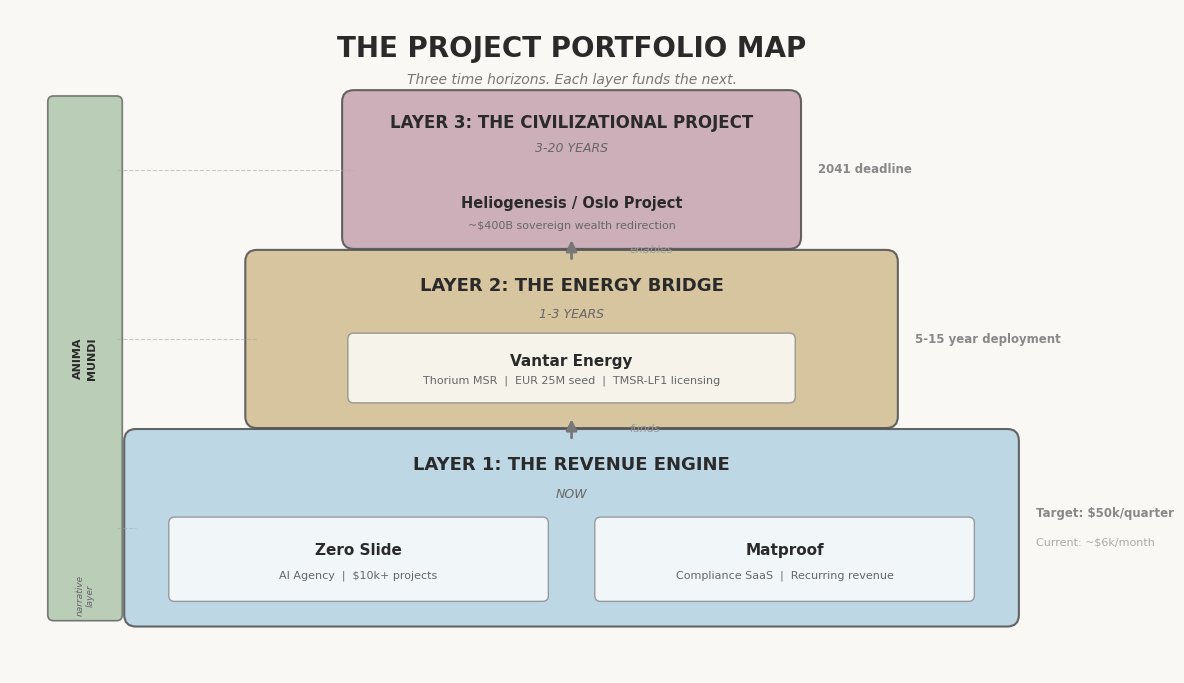
Here's the map.
The Strategy: Freedom First, Then Leverage
I spent years making the mistake that most mission-driven people make. I tried to monetize the mission directly. I wanted to work on civilizational problems from day one, and I kept running into the same wall: civilizational problems don't pay your rent.
The insight that changed everything was embarrassingly simple. You can't work on what matters if you're worried about money. Step one is always financial freedom. Not wealth. Freedom. Enough cash flow that you can say no to projects that don't align, enough runway that you can spend months on something without a clear revenue model, enough margin that a slow quarter doesn't force you back into survival mode.
My target is enough quarterly revenue from consulting and SaaS to live between Berlin and Istanbul, cover all business expenses, fund early-stage activities for bigger projects, and still save. It buys full autonomy to work on what matters.
Most founders I know who care about something bigger than their startup make one of two mistakes. Either they try to build the big thing directly and run out of money, or they get so comfortable with the revenue engine that they never build the big thing at all. The trick is treating the revenue engine as infrastructure, not identity. It's the foundation, not the building.
I think of it as a staircase. Each step funds the next one. The bottom steps are practical and boring. The top steps are ambitious and possibly crazy. But you can't skip steps, and you can't build the staircase from the top down.
Layer 1: The Revenue Engine
This is the work that pays for everything else.
Before diving in, I should mention le melo - a hydration brand I built over the last few years. I'm still involved in daily strategy, but it runs increasingly on its own. Le melo was my first real experience building a consumer product from scratch - sourcing, branding, distribution, the whole thing. A lot of what I learned there about building something people actually want informs how I approach everything below.
Two projects form the core of the revenue engine right now, both designed to generate predictable cash flow.
Zero Slide
Zero Slide is my AI agency. I take on high-ticket projects for SMBs and enterprises that need AI built into their operations. Custom automation, internal tools, AI-powered workflows, integration projects. The work that every company knows they need but can't figure out how to do in-house.
AI consulting is the fastest path to cash flow right now. The demand is enormous and growing. Every mid-size company has a list of processes they know AI could improve, and most of them have already failed at least once trying to implement something with their existing team. They hired a developer who built a chatbot that nobody uses, or they signed up for some enterprise AI platform that required six months of integration work before it did anything useful. They need someone who can come in, understand the business context, and build something that actually works within weeks, not quarters.
The business model is deliberately simple. I take on selective projects, typically scoped to 4-8 weeks. I do the architecture and planning, use AI tools heavily in implementation, and deliver working systems - not prototypes, not proof-of-concepts, but production software that runs the next day. The combination of speed and quality is the competitive advantage. Most agencies take months. I take weeks.
The target is two to three active projects at any given time, which is sustainable without burning out.
The strategic part of Zero Slide isn't the revenue itself. It's the selection of projects. I deliberately take on work in industries I care about: energy, compliance, manufacturing, logistics. Every project teaches me something about an industry that connects to the bigger picture. A compliance automation project for a German manufacturer teaches me about regulatory frameworks. An energy data pipeline project teaches me about grid operations. The consulting isn't just generating money. It's generating knowledge.
Matproof
Matproof is a compliance management SaaS platform. Companies use it to manage their obligations under frameworks like NIS2, DORA, GDPR, ISO 27001, and eight others. Eleven frameworks are live in the product right now.
The thesis behind Matproof is simple: compliance is mandatory spend. Companies don't buy compliance software because they want to. They buy it because regulators will fine them if they don't. This makes compliance one of the most reliable revenue categories in B2B SaaS. Nobody cancels their compliance platform because the economy slows down. If anything, economic downturns increase regulatory scrutiny.
The product is live at app.matproof.com with eleven regulatory frameworks built in, and automated outreach running daily. The go-to-market is straightforward: find companies that are subject to NIS2 or DORA (which is tens of thousands of companies in Europe), show them the platform, and convert them to monthly subscriptions. The play here is recurring SaaS revenue that compounds while I sleep. Every new customer adds monthly recurring revenue that doesn't require my active time after onboarding.
Building Matproof also taught me something I didn't expect. Compliance is one of the clearest windows into how industries actually operate. When you model a regulatory framework, you have to understand every process, every data flow, every accountability structure in a company. That knowledge transfers directly to consulting work and to understanding the regulatory landscape for nuclear energy. The skills compound across layers.
Matproof and Zero Slide together form the financial base. Consulting is high-margin but requires my time. SaaS is lower-margin per customer but scales without me. The combination gives me both immediate cash flow and long-term compounding.
These aren't passion projects. I'm not going to pretend that compliance software makes my heart sing. They're the engine. They fund everything that comes next.
Layer 2: The Energy Bridge
This is where things get interesting.
Vantar Energy
Vantar Energy is a thorium molten salt reactor licensing venture. The goal is to bring China's TMSR-LF1 technology to Europe and eventually the United States.
I need to explain why I'm spending significant time and energy on nuclear power, because from the outside it probably looks like a strange choice for a solo founder who runs an AI agency.
Energy is the foundation layer of everything. Every other transition - materials, food systems, computation, governance - depends on having abundant, cheap, clean energy. The metric that matters is EROEI: Energy Return on Energy Invested. It measures how much useful energy you get back for every unit of energy you spend producing it.
Modern civilization was built on fossil fuels with an EROEI of 30-100:1. Solar and wind deliver 5-15:1 after accounting for storage and intermittency. That's not nothing, but it's not enough to run an industrial civilization, let alone build a new one. You need EROEI above 50:1 to sustain the kind of energy-intensive processes that make everything else possible: desalination, direct air capture, synthetic fuels, industrial heat, materials recycling.
Thorium molten salt reactors can deliver 200-400:1 EROEI. They can burn existing nuclear waste as fuel. They operate at atmospheric pressure, which eliminates the primary failure mode of conventional nuclear. They produce virtually no long-lived waste. And they can scale to planetary energy needs.
The catch is that nobody in Europe or the US has built one. China has. The Shanghai Institute of Applied Physics (SINAP) spent $3.3 billion and fifteen years developing TMSR-LF1. It works. They've run it. The hard physics is done.
But China isn't going to deploy thorium reactors in Europe. Someone needs to license the technology, navigate European regulatory frameworks (EURATOM, ASN in France, SUJB in Czech Republic, ANVS in Netherlands), and bring it to market. That's what Vantar Energy is designed to do.
This is not a research play. It's a licensing and regulatory play. The difference matters. A research play means you're trying to prove that a technology works. That takes billions of dollars and decades. A licensing play means the technology already works and you're navigating the legal and political infrastructure to deploy it somewhere new. That's still hard - European nuclear regulation is genuinely complex - but it's a fundamentally different kind of hard. It's paperwork, politics, and persistence, not physics.
We're raising a seed round. I've engaged regulatory advisors in Paris and Italy. I have a technical dossier from SINAP. I'm in conversations with European nuclear engineers, regulators, and utilities across five countries.
Timeline: 5-8 years to first European deployment if everything goes well. 10-15 years realistically. This is not a startup that's going to IPO in three years. It's a decade-long infrastructure project that could fundamentally change Europe's energy equation.
The connection to Layer 1 is direct. Zero Slide and Matproof revenue funds my time working on Vantar Energy. Every hour I spend on regulatory conversations, investor meetings, and technical due diligence is an hour I'm not billing for consulting. The revenue engine has to run well enough to absorb that.
Layer 3: The Civilizational Project
This is the part that sounds insane at dinner parties.
Heliogenesis
Here's what I believe: the trajectory we're on - extractive supply chains, centralized energy dependence, hollowed-out regional economies - becomes irreversible within the next decade or two. Not in the dramatic, Hollywood sense. In the boring, systemic sense. The path dependencies harden. The institutions that could redirect capital lose the political window to do so. The talent that could build alternatives gets absorbed into optimizing what already exists.
Which means if you're going to do something about it, the window is now. Not "someday when I have more resources." Now. Within the next couple of years at most.
Heliogenesis is my attempt to work at that level. I call it an "Inverse Manhattan Project." The original Manhattan Project concentrated massive resources to build a weapon. Heliogenesis is about concentrating resources to build transition infrastructure - the material, institutional, and coordination layers that a post-extractive civilization actually needs.
The work operates across three vectors. The first is what I call Internal Architecture - how do you sustain the people doing this kind of work over decades without burning them out? You can't build a new civilization while running on fumes. The second is Collective Coordination - how do entities that have no natural mechanism for cooperation (governments, foundations, research labs, companies) actually work together at civilizational scale? The third is Material Independence - the bioregional stack of manufacturing, energy, food, and materials that makes a region genuinely self-sustaining rather than dependent on fragile global supply chains.
None of this works as a startup. It's not a company. It's a political, institutional, and philosophical project that requires partnerships across disciplines - governance design, materials science, institutional finance, deep ecology. The people I'm working with aren't employees. They're co-conspirators who share the conviction that this kind of work is necessary, even if the odds are long.
The connection to everything below it on the staircase is direct. Vantar Energy proves the energy thesis - you can't have bioregional manufacturing without bioregional energy. The consulting and SaaS work funds the time and travel. And the newsletter builds the narrative layer that shifts what people consider possible.
I'm deliberately not sharing the specific mechanisms, partnerships, or institutional strategy here. Not because it's secret, but because at this stage the work is fragile and the details change fast. What doesn't change is the conviction: the window is closing, the resources exist to do something about it, and someone has to try.
Why do I believe this is possible? Because the institutions that control the largest pools of capital on Earth are already asking these questions. Because the political conversation in several countries is shifting toward long-term thinking about resource deployment. And because the alternative - assuming someone else will figure it out - is not a strategy. It's denial.
How the Layers Feed Each Other
The portfolio structure isn't just about diversification. It's about strategic dependency.
Consulting revenue from Zero Slide funds Vantar Energy seed activities and Heliogenesis travel and partnerships. Matproof recurring revenue buys time and autonomy. If Matproof grows enough, I don't need to consult at all. That frees up hundreds of hours per year for Layer 2 and Layer 3 work.
Vantar Energy proves the energy thesis that underpins Heliogenesis. If thorium MSRs can actually deliver cheap, abundant, clean energy to Europe, then the entire Heliogenesis argument about bioregional manufacturing becomes credible. You can't have local production without local energy. Vantar Energy is the proof point.
Heliogenesis provides the integration framework. Energy alone doesn't solve anything. You need materials, governance, food systems, and coordination. Heliogenesis is the layer that connects all of these into a coherent strategy for civilizational transition.
Each layer de-risks the next. If Matproof works, I don't need to consult. If Vantar Energy works, Heliogenesis becomes credible. If Heliogenesis works, everything changes.
And the risk profile is asymmetric in the best possible way. If Layers 2 and 3 fail completely, I still have a profitable AI agency and a SaaS platform. Worst case is a good life with interesting work and financial independence. Best case is meaningful change at civilizational scale. I don't know many other portfolio structures where the downside is "comfortable founder" and the upside is "helped redirect hundreds of billions toward transition infrastructure."
There's also a temporal compounding effect that's easy to miss. Every year I spend on Layer 1, the revenue base grows and becomes more automated, which frees up more time. Every year I spend on Layer 2, the regulatory relationships deepen and the technology pathway becomes clearer. Every year I spend on Layer 3, the political network expands and the narrative gains traction. Time is an ally here, not an enemy. The portfolio gets stronger the longer I run it.
The Anima Mundi Newsletter
There's one more piece that doesn't fit neatly into the three layers because it runs alongside all of them.
Anima Mundi is my newsletter on Substack. I write about energy transition, systems thinking, the intersection of technology and civilization, and the philosophical underpinnings of why any of this matters.
It's not a business. I don't monetize it directly. It's a thinking-in-public practice that serves three functions.
First, it builds intellectual credibility. When I sit down with a nuclear regulator or a sovereign wealth fund advisor, they can read years of published thinking about these topics. That matters. It's the difference between "some random founder with a pitch deck" and "someone who has been thinking carefully about this for years."
Second, it attracts aligned people. Almost every meaningful partnership I've formed in the last two years started because someone read something I wrote and reached out. The newsletter is a filter. It finds the people who care about the same problems.
Third, and most importantly, the newsletter IS the Overton window strategy for Heliogenesis. Every article about thorium energy, bioregional manufacturing, sovereign wealth deployment, or civilizational infrastructure shifts the conversation slightly. One article doesn't change anything. Three hundred articles over five years change what people consider possible. The newsletter is slow, patient, compounding work on the narrative layer.
If the three project layers are the staircase, Anima Mundi is the railing. It doesn't hold weight by itself, but it keeps everything else from falling over.
What I'm Not Building
I think it's worth being explicit about what this is not.
I'm not building a lifestyle business. The goal isn't passive income and a beach somewhere. I respect people who build that, but it's not what I'm doing.
I'm not optimizing for exit. None of these projects are designed to be flipped in five years. Zero Slide and Matproof could theoretically be acquired, but that's not the point of them.
I'm not trying to retire early. I expect to work on some version of these problems for the rest of my life. The revenue engine isn't about escaping work. It's about choosing work.
The goal isn't wealth. The goal is leverage. Enough financial stability to spend decades on work that might actually shift something. Enough credibility to be in the rooms where decisions get made. Enough infrastructure that the big bets have time to play out.
I'm also not pretending I have it figured out. Half of what I've described might not work. Matproof might fail to find product-market fit. Vantar Energy might get stuck in regulatory purgatory for fifteen years. Heliogenesis might turn out to be a beautiful idea that can't survive contact with Norwegian parliamentary politics. All of these are real possibilities.
But the portfolio structure means no single failure is fatal. The staircase can lose a step and still function. That's the entire point of building this way. The people who tell you to focus on one thing are optimizing for the probability of success on that one thing. I'm optimizing for the expected value across a portfolio where the outcomes range from "solid business" to "generational impact." Different optimization target, different strategy.
The Staircase
I started this post trying to answer "what do you do?" and ended up drawing a map of the next twenty years. That's kind of how these conversations always go. There's no short answer because the work doesn't fit in a single category.
The honest answer is: I'm building a staircase. Each step funds the next one. The bottom steps are practical and already generating revenue. The middle steps are ambitious and actively being built. The top step is a civilizational transition that sounds insane when you say it out loud.
But every step beneath it is practical, fundable, and already in motion. The consulting contracts are signed. The SaaS product is live. The regulatory advisors are engaged. The parliamentary vote count is being tracked. None of this is theoretical.
I think there's a version of this strategy that applies to anyone who cares about problems bigger than what a single startup can address. The specifics will be different - maybe your Layer 1 is freelance design instead of AI consulting, maybe your Layer 2 is a climate tech company instead of a nuclear venture, maybe your Layer 3 is education reform instead of sovereign wealth redirection. But the structure works the same way. Build freedom first. Use freedom to build credibility. Use credibility to build leverage. Use leverage to build what actually matters.
The mistake is thinking you need permission to operate at multiple time horizons simultaneously. You don't. You need a revenue engine, a clear strategic logic connecting the layers, and the discipline to not abandon the bottom when the top gets exciting.
And the view from even the middle of the staircase is worth the climb. Even if Heliogenesis never achieves its full ambition, the process of building toward it has already introduced me to extraordinary people, forced me to think at time scales most founders never consider, and given me a framework for deciding what to work on that I trust completely. The framework itself is the most valuable thing I've built. It answers every question about what to say yes to and what to say no to. If it doesn't fund, enable, or accelerate one of the three layers, I don't do it.
If you're reading this and you see yourself in any of it - the frustration of having ambitions that don't fit in a single company, the tension between needing revenue now and wanting to work on what matters, the feeling that the really important problems are too big and too slow for traditional startup structures - I'd encourage you to think about your own staircase. What's the bottom step that generates freedom? What's the middle step that builds credibility? What's the top step that you'd spend decades on if money were no object?
You probably already know the answers. The hard part isn't figuring out what to build. It's having the patience to build the steps in order.