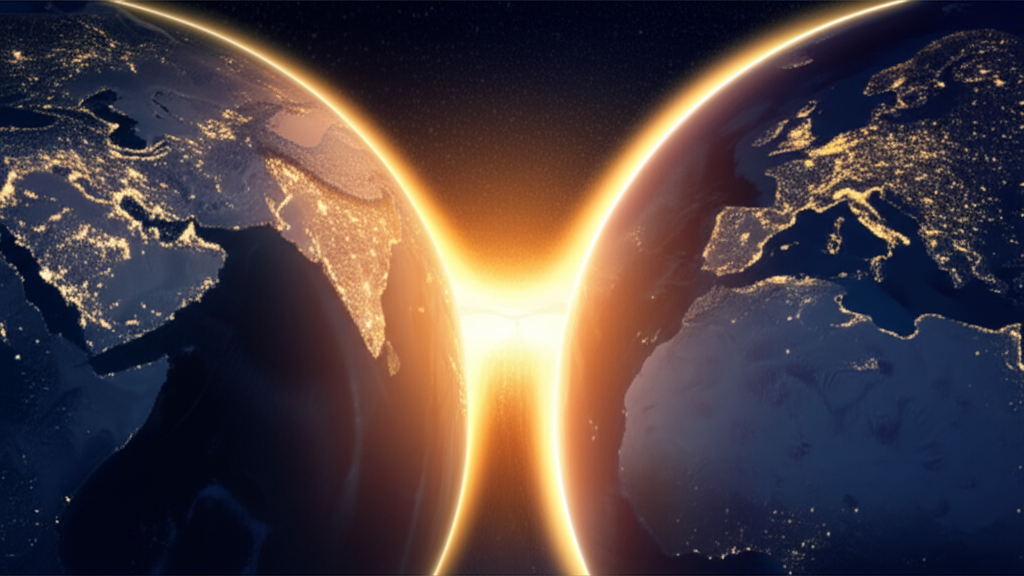
India and Europe do not appear in the same sentence often enough. One is a 1.4 billion person subcontinent racing toward industrialization. The other is a 450 million person continent struggling with deindustrialization. They occupy different geographies, different income brackets, different positions in the global economy.
But they share a problem that connects them more deeply than most analysts recognize: both are energy-import dependent, both have limited uranium, both sit on significant thorium reserves, and both are watching China build the nuclear technology that both will eventually need.
The strategic logic of an India-Europe thorium partnership is not subtle. It is obvious. What is missing is not the rationale but the imagination to act on it.
The shared problem
Energy import dependency
India imports approximately 85% of its oil and 50% of its natural gas. The annual energy import bill is roughly $150 billion - money that flows out of the Indian economy every year, creating a permanent current account drag and a strategic vulnerability to supply disruption.
Europe imports approximately 60% of its total energy. Before 2022, roughly 40% of European gas came from Russia. The emergency pivot to LNG after the invasion of Ukraine replaced one dependency with another - European LNG now comes from the US and Qatar, at significantly higher cost, through infrastructure that took years to build.
Both India and Europe are structurally dependent on imported energy. Both pay a strategic premium for that dependency. Both would benefit enormously from a domestic energy source that does not require imports.
Limited uranium
India's domestic uranium reserves are modest - enough to fuel its current reactor fleet for decades but nowhere near enough for the massive nuclear expansion that Indian energy demand requires. India's uranium supply depends on imports from Kazakhstan, Canada, and Australia.
Europe's position is similar. France's reactor fleet - the backbone of European nuclear - runs on uranium imported from Kazakhstan, Niger, Canada, and Australia. The enrichment services that convert natural uranium into reactor fuel come significantly from Russia's Rosatom.
Both regions face a nuclear fuel supply chain that runs through countries they cannot fully control.
Thorium abundance
India holds the world's largest thorium reserves: approximately 846,000 tonnes, concentrated in monazite beach sands along the Kerala coast and in deposits across Andhra Pradesh, Tamil Nadu, and Odisha. This is enough to power Indian civilization for centuries.
Europe's thorium deposits are less concentrated but significant. Norway has substantial thorium in its mineral sands and rock formations. Sweden, Finland, and France have deposits associated with rare earth mineralization. Combined European thorium resources are sufficient for a large-scale MSR deployment programme.
Neither India nor Europe has enough uranium for long-term energy independence. Both have enough thorium.
The China factor
Both India and Europe are watching China's TMSR program with a mixture of admiration and concern. China's 700-researcher, $3.3 billion thorium MSR programme is the most advanced in the world. The TMSR-LF1 is operational. The commercial TMSR-LF2 is planned for the early 2030s.
For India, Chinese thorium leadership threatens to make India's 70-year investment in thorium fuel cycle research strategically irrelevant. If China commercializes thorium MSRs first, India's deep but slower-paced programme becomes a follower rather than a leader.
For Europe, Chinese thorium leadership means eventual dependency on Chinese nuclear technology - the energy sovereignty problem described in detail elsewhere on this blog.
Both India and Europe have strategic reasons to develop thorium MSR technology independently of China. Neither has the complete capability to do it alone. Together, they complement each other almost perfectly.
India's thorium programme: the 70-year bet
In 1954, Homi Bhabha - the father of India's nuclear programme - laid out a three-stage plan to take India from uranium-based nuclear power to thorium-based energy independence. Seven decades later, India is still executing that plan.
Stage 1: Pressurized Heavy Water Reactors (complete)
India operates 22 pressurized heavy water reactors (PHWRs) using natural uranium fuel. These reactors are the foundation - they generate electricity and produce plutonium as a byproduct in their spent fuel.
India chose PHWRs specifically because they use natural uranium (no enrichment required) and produce plutonium efficiently. The choice was strategic from day one - PHWRs were selected not for their own merits alone but because they produce the plutonium needed for Stage 2.
Stage 2: Fast Breeder Reactors (in progress)
The Prototype Fast Breeder Reactor (PFBR) at Kalpakkam uses plutonium from Stage 1 as fuel and breeds more fissile material than it consumes. Critically, the PFBR can be configured to breed U-233 from thorium blankets surrounding the core.
The PFBR has experienced significant delays - originally planned for 2010, it has been pushed back repeatedly. But it is under construction and approaching completion. Once operational, it demonstrates the bridge between India's uranium-based present and thorium-based future.
India is also planning larger fast breeder reactors (FBR-1 and FBR-2, each 600 MWe) that will explicitly incorporate thorium blankets for U-233 production.
Stage 3: Thorium-based reactors (the endgame)
The ultimate goal: reactors that run primarily on thorium, using U-233 bred in Stage 2 as the initial fissile driver. Once enough U-233 is available, the thorium cycle becomes self-sustaining - breeding more fuel than it consumes.
India's Advanced Heavy Water Reactor (AHWR) is designed for this stage - a 300 MWe reactor using thorium with plutonium and U-233 as drivers. The AHWR design is approved for construction.
And there is KAMINI - a 30 kW research reactor at Kalpakkam that is the only reactor in the world currently operating on U-233 fuel. Small, but symbolically and scientifically significant: India has already demonstrated the endpoint of the thorium fuel cycle.
The strategic depth
What makes India's thorium programme unique is not any single reactor or facility. It is the institutional depth:
- 70 years of continuous thorium fuel cycle research at BARC
- Multiple generations of nuclear engineers trained specifically on thorium chemistry
- Operating experience with U-233 (no other country has this)
- Massive thorium processing capability from monazite sands
- A complete intellectual framework for how to transition from uranium to thorium over a multi-decade timescale
No other country has this depth. China has more money and more researchers working on MSR technology, but India has more accumulated knowledge of the thorium fuel cycle itself. These are different things, and both matter.
What India has that Europe does not
Thorium fuel cycle expertise. India has been studying thorium chemistry, U-233 production, and thorium reactor physics for 70 years. Europe has essentially zero institutional experience with thorium fuel cycles.
Operating experience with U-233. KAMINI is the only U-233 fueled reactor in the world. The operational data - neutronics, safety behavior, fuel handling - is invaluable and exists nowhere else.
Massive thorium reserves. 846,000 tonnes, the world's largest. Enough for centuries of energy production.
A generation of thorium-trained engineers. Indian nuclear engineers at BARC, IGCAR (Indira Gandhi Centre for Atomic Research), and Indian universities study thorium fuel cycle as a core part of their training. This human capital cannot be created quickly.
The fast breeder pathway. India's PFBR and planned FBRs provide the bridge technology for producing U-233 from thorium at scale - the startup fuel that any thorium reactor fleet needs before breeding becomes self-sustaining.
Institutional patience. India's three-stage programme has survived changes of government, economic crises, international sanctions, and seven decades of execution. The commitment to thorium is bipartisan and institutional, not dependent on any single political leader.
What Europe has that India does not
Capital. European sovereign wealth funds, development banks, and institutional investors collectively manage trillions of euros. The Norwegian Government Pension Fund Global alone holds $1.7 trillion. The European Investment Bank can mobilize tens of billions for strategic infrastructure. India's nuclear programme has been chronically underfunded relative to its ambition.
Advanced materials science and manufacturing. Hastelloy-N, SiC composites, precision nuclear instrumentation, advanced welding and inspection technologies - Europe's industrial base excels at the high-end manufacturing that MSR deployment requires. India's materials manufacturing capability is growing but does not yet match European precision in nuclear-grade alloys and composites.
Regulatory credibility. A reactor design licensed by ASN (France), STUK (Finland), or ONR (UK) carries global credibility. International markets trust European safety certification. India's nuclear regulatory body (AERB) is competent but lacks the international recognition that European regulators command.
Industrial demand. Europe's electricity market consumes approximately 3,000 TWh per year, worth EUR 300 billion+. European industry needs roughly EUR 100 billion per year in process heat. This is an enormous, wealthy, immediate market for MSR technology. India's market is large and growing but lower-value per unit.
Diplomatic weight in nuclear governance. France and the UK are permanent members of the UN Security Council and nuclear weapons states. European nations are dominant voices in the IAEA, the Nuclear Suppliers Group, and nuclear non-proliferation governance. Europe sets global nuclear standards. India, despite its large nuclear programme, has operated partially outside the global nuclear governance framework since its 1974 nuclear test, and only gained NSG waiver in 2008.
The partnership opportunity
Joint thorium fuel cycle R&D
Combine India's 70 years of thorium chemistry and U-233 experience with European materials science and manufacturing capability. Specific areas:
- Salt chemistry: Indian thorium processing expertise applied to FLiBe salt optimization
- U-233 handling: Indian operational experience informing European safety analysis
- Materials testing: European Hastelloy-N and SiC composite expertise applied to Indian reactor designs
- Online reprocessing: joint development of bismuth extraction and fluorination systems using Indian radiochemistry experience and European precision manufacturing
Shared licensing frameworks
Develop MSR safety assessment methodologies jointly between Indian (AERB) and European regulators. Neither has MSR licensing experience. Building that expertise together - sharing the intellectual investment - is more efficient than developing it independently in parallel.
A reactor design co-developed by India and Europe, licensed jointly by Indian and European regulators, would have immediate global credibility. Countries in Africa, Southeast Asia, and Latin America looking for MSR technology would prefer a jointly certified design over a unilateral Chinese one.
Supply chain cooperation
India supplies: thorium feedstock, thorium processing expertise, U-233 production capability (via fast breeders), thorium fuel cycle chemistry Europe supplies: Hastelloy-N and advanced alloys, SiC composites, precision instrumentation, nuclear-grade manufacturing, Li-7 enrichment (once built), capital
Neither side depends on the other for everything. Both contribute capabilities the other lacks. The supply chain is balanced, not asymmetric.
Joint venture reactor development
A European-Indian MSR company, jointly owned and jointly managed, developing a thorium MSR design for deployment in both markets. European capital, Indian thorium expertise, shared IP.
This is not unprecedented. India and France already have deep nuclear cooperation - the Jaitapur EPR project involves six European Pressurized Reactors to be built in Maharashtra, representing the largest nuclear deal in history. Extending this partnership from French PWR technology to joint thorium MSR development is a natural evolution.
Technology co-ownership
The critical strategic advantage: neither India nor Europe depends on China. Both maintain technology sovereignty. The IP is jointly owned, deployed in both markets, and available for licensing to third countries on terms that India and Europe jointly control.
This is the opposite of the dependency model. It is a partnership model - two parties with complementary strengths building something together that neither could build alone, on terms that both control.
The diplomatic vehicle
The EU-India Trade and Technology Council, established in 2023, provides an existing institutional framework for technology cooperation. Its stated goals include cooperation on clean energy, critical and emerging technologies, and supply chain resilience.
Thorium MSR technology fits every one of those categories. Adding a thorium energy cooperation track to the TTC would be the fastest way to formalize the partnership.
Beyond the TTC:
- India-France nuclear cooperation: Already deep (Jaitapur, submarine technology sharing). France is the natural European lead for thorium cooperation with India.
- India-EU Strategic Partnership: Upgraded in 2020, includes energy and climate cooperation mandates.
- International Solar Alliance: India co-founded this 120-country alliance. Adding nuclear cooperation (thorium as complement to solar for baseload) would broaden its scope meaningfully.
- IAEA technical cooperation: Joint India-EU submissions to IAEA technical programmes for MSR safety standards development.
The diplomatic infrastructure exists. What is missing is the political decision to use it for thorium.
Why this beats going alone
Europe alone: Has capital and manufacturing but is 20+ years behind on thorium fuel cycle chemistry. Would need to build thorium expertise from scratch, duplicating work India has done over 70 years.
India alone: Has the science and the fuel but lacks the capital for rapid MSR development and the materials manufacturing for deployment at scale. India's nuclear programme has been constrained by funding throughout its history.
China alone: Has both scale and expertise, but will not share meaningfully. Chinese technology transfer comes with strategic strings. China's MSR programme is a national strategic asset, not an export product offered on equal terms.
Europe + India: Complementary strengths, shared strategic interest, balanced partnership. India accelerates its thorium deployment by a decade through European capital and materials. Europe leapfrogs 70 years of thorium fuel cycle development through Indian expertise. Both gain technology sovereignty. Neither depends on China.
The Airbus model applied to nuclear
Airbus was created because no single European country could compete with Boeing alone. France, Germany, the UK, and Spain pooled aerospace capabilities into a joint venture that now leads the global market.
The thorium MSR opportunity has the same structure. No single country - not France, not India, not Czech Republic - can match China's integrated TMSR investment alone. But India and Europe together have every capability needed: fuel, science, materials, capital, regulatory credibility, and market demand.
The institutional model that built Airbus - multinational cooperation with shared IP, shared investment, and shared returns - is exactly what thorium MSR commercialization requires.
The geopolitical framing
India as the swing state
India is the most strategically significant country in 21st-century energy geopolitics. It is simultaneously:
- The world's most populous country
- The fastest-growing major economy
- The world's third-largest energy consumer (and rising fast)
- The holder of the world's largest thorium reserves
- Courted by both China (Belt and Road, reactor exports) and the West (defense partnerships, tech cooperation)
Where India's energy technology goes, a significant portion of the developing world follows. India is a reference customer for energy technology - if India deploys thorium MSRs, dozens of other countries will evaluate the same technology.
Ensuring that India deploys jointly-developed, jointly-governed thorium technology rather than Chinese-supplied technology is one of the highest-leverage strategic investments the West can make.
The democratic technology alliance
There is a broader strategic frame: democratic nations cooperating on critical technology to prevent authoritarian monopolies.
This is already happening in semiconductors (CHIPS Act, US-Japan-Netherlands export controls), in AI (G7 AI safety frameworks), and in telecommunications (post-Huawei 5G coordination). Energy technology is the next domain.
A democratic thorium alliance - anchored by India, France, and the UK, with participation from Japan, South Korea, Canada, and Australia - would ensure that the most transformative energy technology of the 21st century is developed under democratic governance, with transparent safety standards, and available on fair commercial terms.
The alternative is a Chinese monopoly on thorium MSR technology, deployed globally under Chinese terms, with strategic leverage attached.
What the West can offer India
Beyond defense deals and diplomatic statements, what concrete technology cooperation can Western nations offer India?
Thorium MSR partnership is a genuinely compelling offer:
- European capital to accelerate India's 70-year thorium programme by a decade
- Access to European precision manufacturing for reactor components
- European regulatory certification that makes Indian-designed technology globally exportable
- Joint ownership of technology that India has been building toward for 70 years - recognition and partnership, not extraction
This is not charity. It is mutual strategic interest expressed through technology cooperation. India gets acceleration and global market access. Europe gets thorium expertise and fuel cycle capability. Both get independence from Chinese technology dominance.
The question
India and Europe are natural thorium partners. One has the science and the fuel. The other has the capital and the market. Both need energy independence. Both are watching China pull ahead.
The strategic logic is clear to anyone who looks at the capabilities map for more than five minutes. India's thorium fuel cycle expertise plus European materials science and capital plus shared regulatory development equals a thorium MSR capability that rivals or exceeds China's - and belongs to democratic nations.
The physics does not care about diplomatic niceties. The thorium fuel cycle works the same way whether it is developed in Shanghai, Mumbai, or Paris. The question is who develops it, who owns it, and who controls the terms on which it is deployed globally.
Right now, China is answering that question by default - because nobody else is building at scale.
India and Europe, together, can change that answer. They have every capability needed. What they lack is the strategic imagination to act - and the political leadership to make the first call.
Someone in Brussels or Delhi needs to pick up the phone.