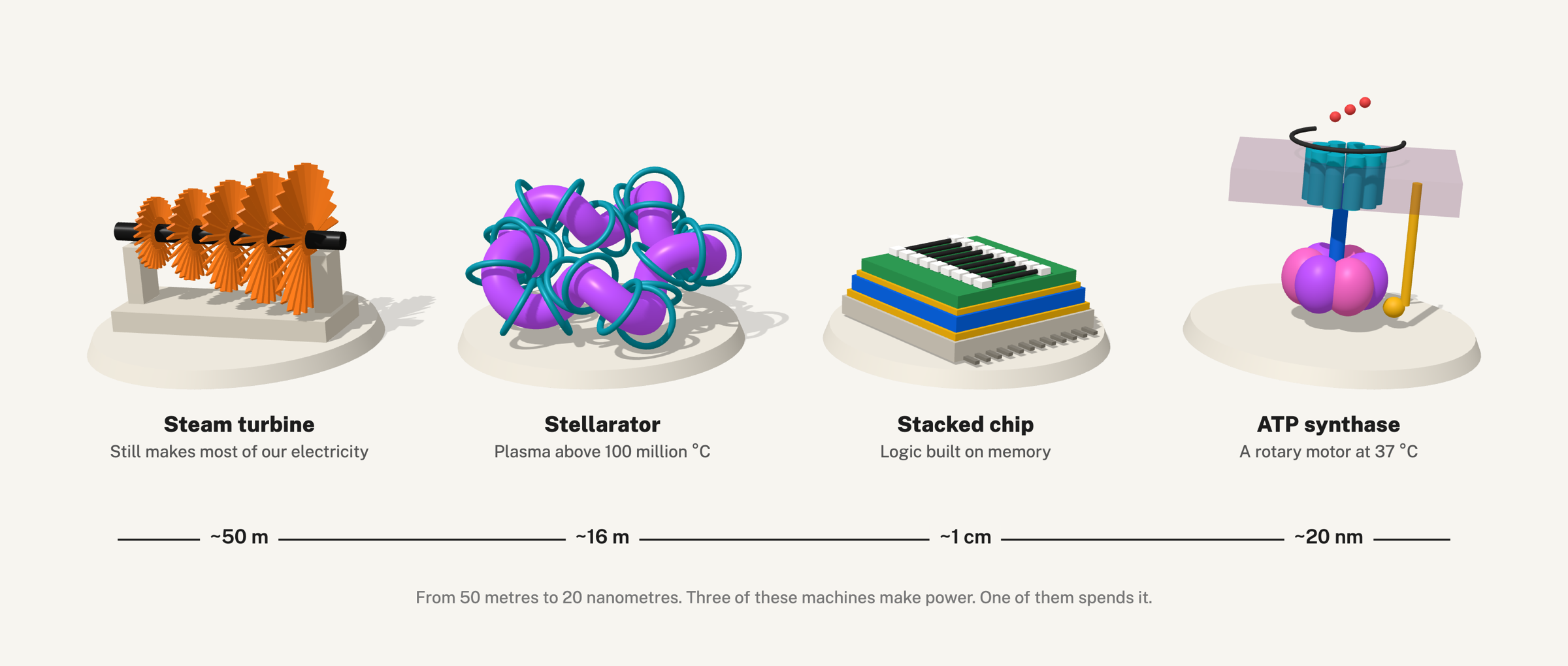
Every cell in your body contains a turbine. It is about 20 nanometres long, it is spun by a flow of protons, and it runs at 37 degrees C. When Hiroyuki Noji and Kazuhiko Kinosita's group put a fluorescent filament on one in 1997 and watched it through a microscope, it rotated. In a follow-up paper in Cell the next year they measured the work it did per step and found it was roughly equal to the free energy available in the chemistry. Close to 100% efficient.
A good coal plant manages somewhere around 35 to 40%.
I have been thinking about that gap more since the last post. The chip work with Jeremy Barton is about moving fewer bits and placing devices without heat. Somewhere in every conversation about it the same question comes back from the other direction. Fine, the chip uses less. What powers it?
So this is a thought experiment on the energy side. To be clear, we do not work on energy. It is an idea I keep coming back to, nothing more. I will go down the scale, from big to small, and try to be honest about which rungs arrive in time.
The chip does not remove the power plant
Start with the demand, because it is the reason any of this is urgent.
The IEA's April 2026 update puts data centre electricity at about 485 TWh in 2025, up 17% in a year, with AI-focused sites growing about 50%. Their 2030 figure is roughly 950 TWh. The whole world generated around 32,000 TWh last year, which works out to an average of about 3.6 terawatts running continuously.
950 TWh is only about 3% of that. The problem is not the share. The problem is that it arrives in a few places, fast, and wants power 24 hours a day.
A better chip helps. If you delete the trip between memory and logic, which is the whole point of building logic on memory, you get more work out of each watt. But cheaper compute has never in history led to less compute. It leads to more. I expect that whatever we save per operation will be spent several times over, and I would be lying if I sold the chip as the answer to the grid.
It buys time. Someone still has to build the generation.
What actually arrives before 2030
Here is the uncomfortable list. It is mostly things we already know how to build.
| Source | Where it is now (Sept 2026) | Realistic timing |
|---|---|---|
| Gas turbines | GE Vernova reported a 116 GW gas backlog in Q2 2026. Large units are booked through 2028. | Now, if you ordered in 2024 |
| Fission restarts | Palisades started loading fuel on 30 August, then paused after a fuel assembly tipped. Crane (the old Three Mile Island 1, contracted to Microsoft) targets 2027. Duane Arnold (Google) targets 2029. | 2027 to 2029 |
| Enhanced geothermal | Fervo's Cape Station in Utah put its first power on the grid on 24 September. Google signed a 396 MW PPA for it this month. | Now, and growing to 2028 |
| Solar and batteries | Fastest to build, but a data centre wants steady power at 3 am | Now |
| Fusion | No plant has produced net electricity | 2030s at the earliest |
Two things surprise me about this table.
The first is how much of the near future is old technology pushed harder. Three reactors that were shut down are being brought back, and one of them had a fuel-handling incident during loading. The steam turbine I wrote about in Civilization Still Boils Water is still the thing on the end of almost every row.
The second is geothermal. Fervo drills with oil and gas techniques and makes steady power from hot rock. It is the one row where something new is actually arriving on schedule, and I think Europe is paying far too little attention to it.
Fusion, and why the German machine matters
Fusion is the row everybody wants to talk about. It deserves a careful look, because two different machines are racing and they fail in different ways.
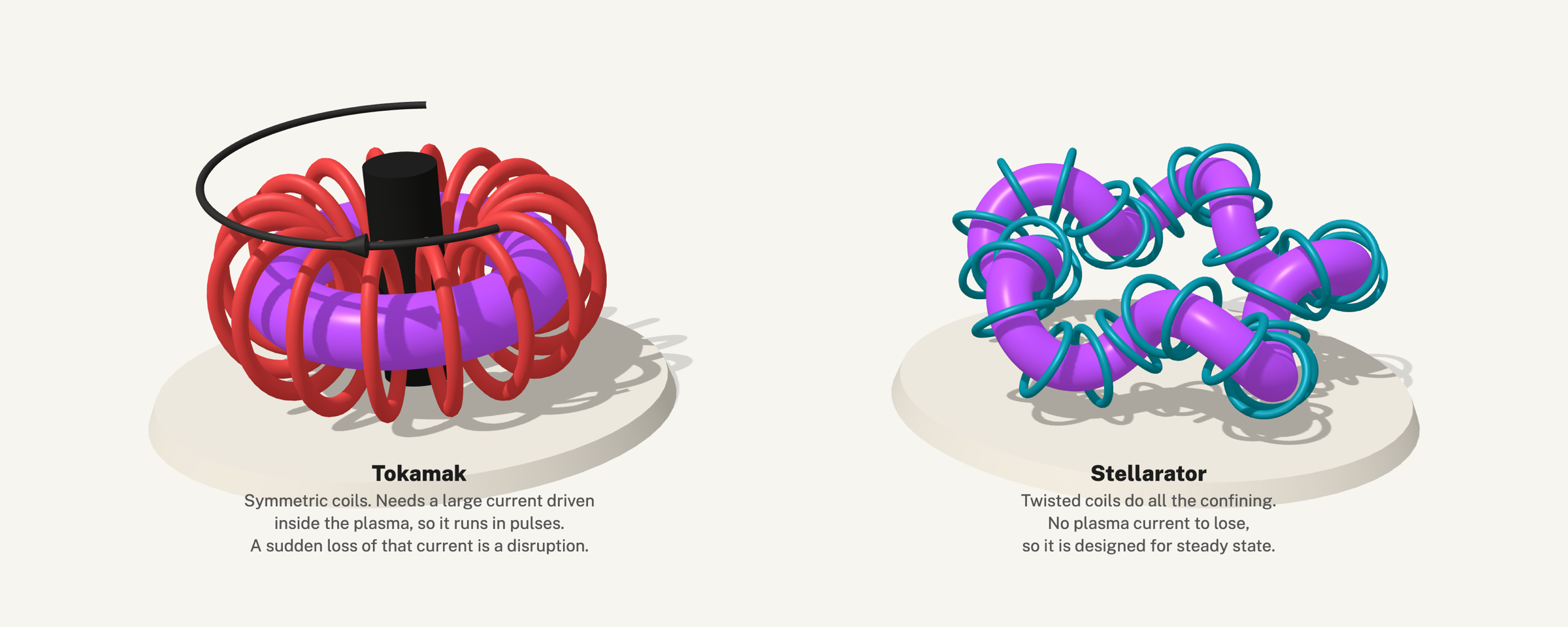
A tokamak, the design used by ITER and by Commonwealth Fusion Systems, confines the plasma partly with a large electric current driven through the plasma itself. That current is usually induced by the central solenoid, like a transformer, so the machine runs in pulses. If the current collapses you get a disruption, and a disruption in a large machine can damage the walls.
A stellarator puts all the work into the shape of the coils. The magnetic field is twisted from outside and no plasma current is needed, so in principle it can run in steady state. The price is the geometry. The coils in the picture are simplified. Real ones are computed by optimisation codes and have to be built to millimetre tolerances.
Where the two stand, as far as I can tell:
- Commonwealth Fusion Systems is building SPARC in Massachusetts. First plasma was once targeted for 2025, then late 2026, and is now 2027. Their power plant, ARC in Virginia, has a 200 MW agreement with Google and aims for the early 2030s.
- Helion has a deal to deliver power to Microsoft from 2028 and is building its Orion plant in Washington state. It ran deuterium-tritium fuel in its Polaris machine in January. It has quietly changed Polaris' goal from net electricity to "demonstrating electricity".
- Proxima Fusion in Munich is the stellarator bet. It raised €130M in 2025 and a further €411M in July at a valuation above €2.4B. It plans a demonstration machine, Alpha, in Garching for 2031. Bavaria has committed support. The federal money is still being negotiated.
- Wendelstein 7-X, the Max Planck research stellarator that Proxima's founders came out of, set a record in May 2025 for sustained performance over a 43-second discharge.
I want to be fair to tokamaks here. The duration records are held by tokamaks: EAST in China ran for 1,066 seconds in January 2025 and WEST in France for 1,337 seconds a month later. Steady state for a stellarator is a design property, and it has not yet been shown at power plant conditions.
I still think the stellarator is the right shape for what data centres want. A computing load does not care about peak output. It cares about the plant being on at 3 am in February for twenty years. That is a stability problem more than a power problem, and the stellarator attacks stability directly.
It is also the one frontier energy technology where Germany is genuinely in front. I have argued before that Europe has forgotten how to build the things it invents. This would be a strange one to lose.
None of it powers anything before 2031. I also already wrote about the fuels beyond deuterium-tritium, like proton-boron, that could skip the steam cycle. Those are further out again, and every efficiency number you see for direct conversion today is a company claim or a calculation, not a measurement.
Biology does it cold
Now go down eight orders of magnitude.
A resting human runs on about 100 watts. The brain takes about 20 of them. To do that, your body turns over roughly its own weight in ATP every day, and almost all of it is made by the machine from the opening of this post.
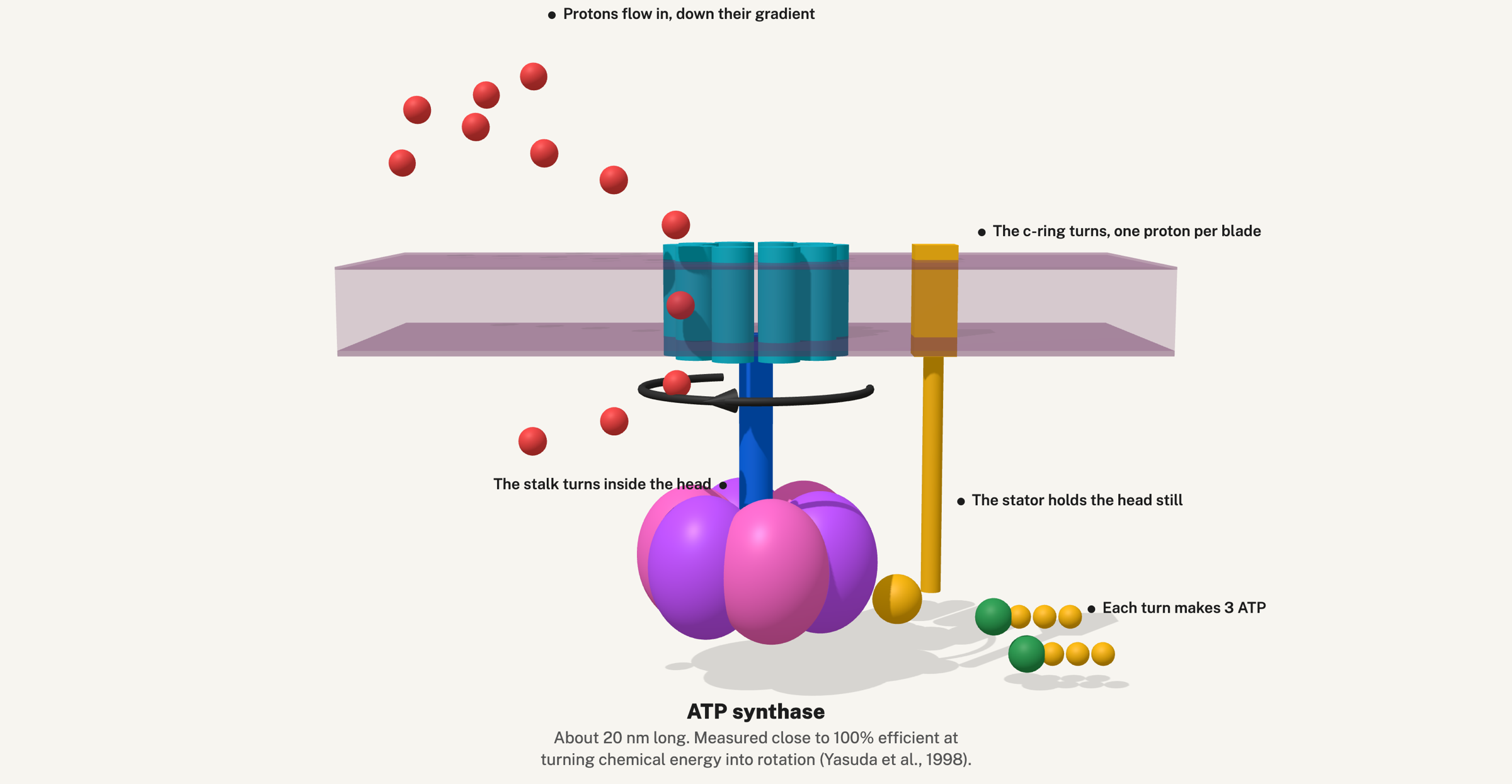
The mechanism is worth walking through slowly, because it is the most elegant generator I know.
A membrane separates two sides with different proton concentrations. The only way through is a ring of small protein blades, the c-ring. A proton lands on a blade, the ring turns a notch, and the proton leaves on the other side. The ring is fixed to a stalk. The stalk turns inside a head made of six subunits, which is held still by a stator arm. Each third of a turn squeezes one of the subunits into a shape that forces ADP and phosphate together into ATP.
Three ATP per full turn. In mammals the ring has eight blades, so about 2.7 protons per ATP. In yeast it has ten. The top speed measured on the isolated head is around 130 revolutions per second.
That is a generator. Flow in, rotation, chemical energy out, no heat step anywhere.
People have tried to borrow this for energy, and the results are worth knowing because they calibrate the hype:
- The Bionic Leaf 2.0 from Daniel Nocera and Pamela Silver's groups at Harvard (Science, 2016) reached about 10% solar-to-biomass efficiency, using bacteria to turn hydrogen and CO₂ into biomass and liquid fuels. That is roughly ten times a typical crop. The number assumes an 18% efficient solar panel feeding it, which people usually leave out.
- Microbial fuel cells use bacteria like Geobacter that pass electrons directly onto an electrode. The best pure-culture result I know, from Kelly Nevin and Derek Lovley's lab in 2008, was about 1.9 W per square metre. A solar panel in full sun makes about a hundred times that.
So biology is not going to power a data centre. It works at the other end. It shows you can make useful, directed energy conversion at the nanometre scale at room temperature, which is the property the chip project needs.
How do you power a machine made of proteins?
This is the question that got me writing.
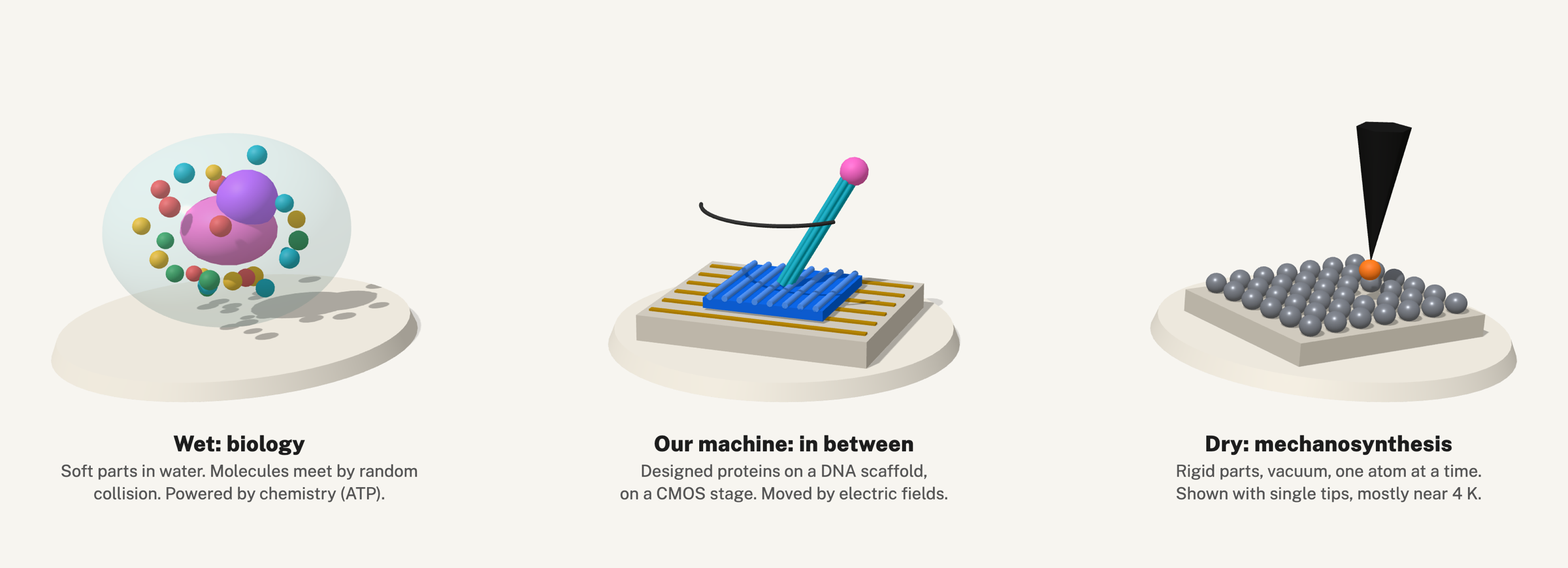
There are two traditions in building things at the molecular scale. Biology is wet: soft parts in water, molecules meeting by random collision, energy from chemistry. The old dream of mechanical nanotechnology is dry: rigid parts, vacuum, atoms placed one at a time by a tip. The dry version has now been shown on hydrogenated silicon with single tips, mostly near 4 kelvin, at good yields. It is beautiful and it is slow.
The machine Barton designs sits between the two. The arms are designed proteins mounted on a DNA scaffold, so they are made by biology. They sit on a MEMS and CMOS stage, so they are addressed like electronics.
If you follow the idea through, the energy question gets concrete. A cell powers its machines with ATP. We cannot sensibly feed ATP to ten thousand arms on a wafer and control each one. So the arms have to be driven by something the chip underneath can switch.
The literature already points the way:
- In 2018 Friedrich Simmel's group at TU Munich built a 25 nm DNA arm on an origami plate and swung it with external electric fields, switching in milliseconds (Kopperger et al., Science). That is about 100,000 times faster than the chemical switching DNA machines used before.
- In 2022 Hendrik Dietz's lab built a DNA rotary motor that turns in an alternating electric field and delivers about 10 piconewton-nanometres of torque (Pumm et al., Nature).
- In 2023 Cees Dekker's group and collaborators made a DNA turbine sitting in a nanopore, driven by a flow of ions across a membrane (Shi et al., Nature Nanotechnology). That one is almost exactly ATP synthase's trick, rebuilt from DNA.
The first two would be the interesting ones for a machine like this, because an electric field is something a CMOS stage can make locally, under software control.
Here is a back-of-envelope number I find useful. One ATP molecule in a cell delivers roughly 80 to 100 piconewton-nanometres of work. An arm pushing with 10 piconewtons over 2.5 nanometres does 25. So one placement motion costs about a third of an ATP. Even at a trillion motions per second across a large array, the mechanical work is in the tens of nanowatts.
The motion is almost free. What costs energy is everything around it: the electronics that generate and switch the fields, the sensing, the readout, the control plane. I do not have a measured number for that yet, and I would treat anyone's number for a system like this with suspicion. My guess is that the power budget of such an assembler would be dominated by ordinary CMOS, which is the part the semiconductor industry is best at making efficient.
What I do not know
A few things I cannot answer yet.
Field crosstalk. Driving one arm with a local field without nudging its neighbours is an electrostatics problem at a scale where water, ions and the DNA itself all screen and distort the field. The Munich arm was driven by fields across the whole sample. Addressing single arms is a different problem.
Whether the arms can stay wet. Proteins and DNA want water and salt. CMOS wants neither. Where exactly the wet part would end and the dry part begin on a stage like this is an open question.
The timeline of the grid. If Helion, CFS and Proxima all hit their dates, the early 2030s look very different. None of them has produced net electricity. I would not plan a data centre on any of them, and I am not planning the company on them.
The ladder
Put the four machines on one line and the pattern is easy to miss because the scales are so different.
A steam turbine, 50 metres long, turns a flow of hot gas into rotation. It still makes most of our electricity. A stellarator, 16 metres across, is trying to build a better source of heat for the same turbine, and a harder version might one day skip it. A stacked chip, a centimetre wide, is where that electricity gets spent, and our job is to make it spend less. ATP synthase, 20 nanometres long, turns a flow of protons into rotation and then into chemistry, with almost nothing lost.
Only the smallest one works without a heat step.
For the next five years the answer to what powers the chips is dull: gas, restarted reactors, geothermal wells, and a lot of solar and batteries. For the 2030s it might be a twisted magnet in Bavaria. Inside the chip, and inside the machine that builds it, the answer is going to look a lot more like the cell. Small electric pushes, precisely placed, where the energy goes into the work and not into heat.
None of this is a project. It is an idea, and I wanted to write it down before it got lost.